 Employee Handbook
Welcome to Great Lakes Energy!
Welcome to Great Lakes Energy!
If you haven’t already, you soon will come to realize what a great place Great Lakes Energy is to work. We take great pride in our culture here and are continually working together to ensure our culture grows with the innovative energy and communication programs and services we provide for our members. It is the responsibility of all of us to make sure this happens!
At Great Lakes Energy, our people are our greatest resource. Working together, we are dedicated to empowering and enriching the lives of our members.
As President & CEO, it is because of all of you that I feel our staff is the best in the business. Together, we can achieve any goal and overcome any obstacle. It is my honor and pleasure to be part of the team with each of you!

We believe this mission is a worthy one.
We have a set of core principles which help us carry it out.
Our Guiding Principles
Great Lakes Energy Origins
Where we come from.
Our Story
Our Executive Leadership Team








Our Compasses
Who we are and what we believe.
Our Culture Drivers
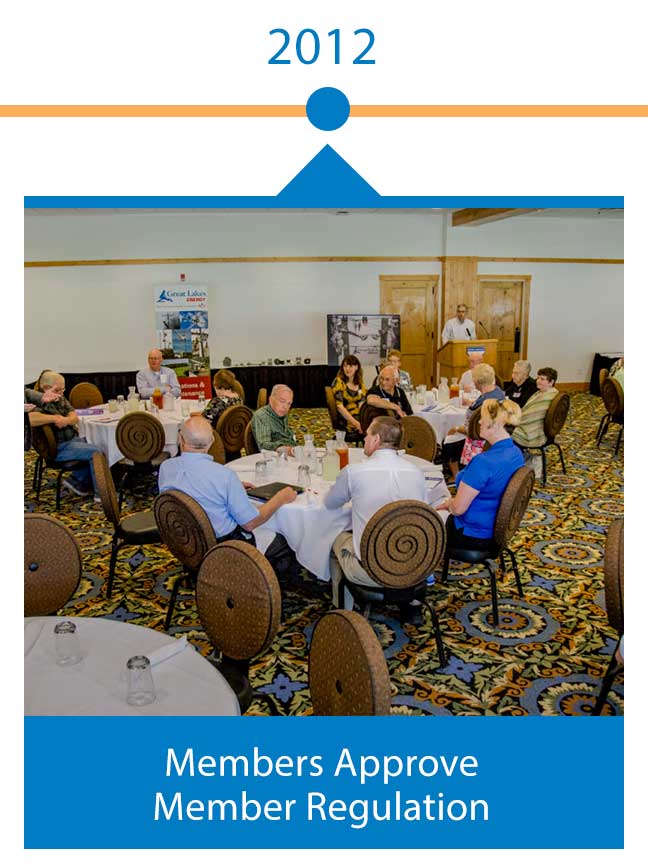
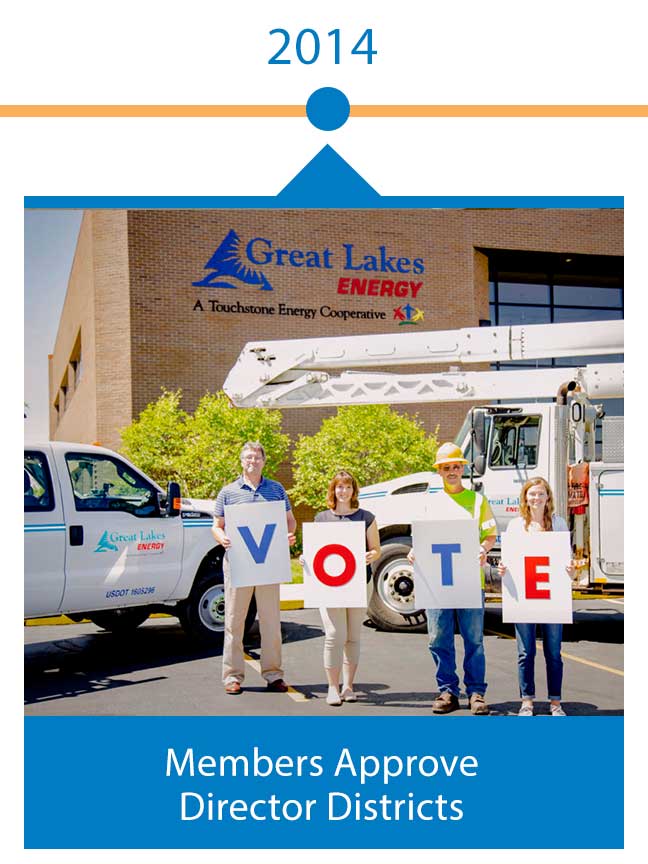
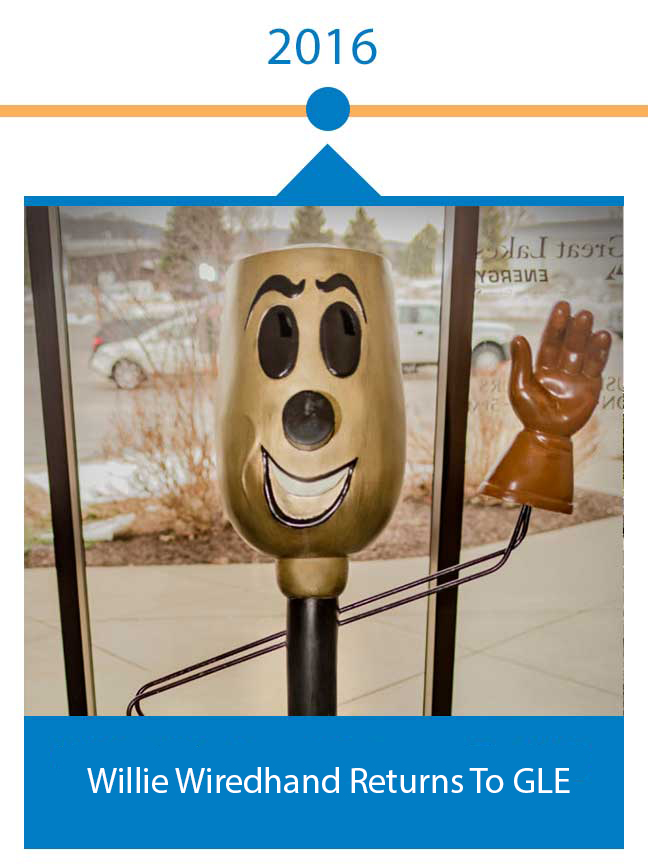
Our History












General Information
How we do things around here.
Working with Great Lakes Energy
Whether you’re brand new to Great Lakes Energy (GLE) or have been with us for a while, we’re confident in saying that this is simply a great place to work, and we look forward to a productive and successful employment relationship. We hope you feel the same.
This handbook is designed to be a valuable resource for employees, so it will change from time to time. As a new hire with GLE and periodically throughout your employment you’ll be asked to acknowledge your responsibility to familiarize yourself with and to follow the policies set forth in this handbook. We’re providing it electronically and we urge you not to print hardcopies. View it online instead so that every time you look you’ll know you’re referencing the most current, relevant information. This can be done on any computer/tablet/phone with an internet connection.
What you’ll find here are general policies, practices and information offered as a guide for our employer/employee relationship. It’s not comprehensive and will not address every possible application, or exception. Throughout our handbook you’ll find references to The Wire, which is GLE’s Intranet. It provides lots of supplemental details for employees that aren’t spelled out in the handbook. We reserve the right to change the items we describe in the handbook or on The Wire, including, but not limited to, leave schedules, benefit offerings and providers, pay practices, etc. If you have questions about what you find (or don’t find) here, you should ask our human resources professionals.
Our handbook applies to all employees…full and part-time, hourly and exempt, management, and employees working in positions included in the bargaining unit. Bargaining unit positions are those covered by the Labor Agreement between GLE and the International Brotherhood of Electrical Workers, Local 876 (IBEW). Many years ago a group of employees voted to be represented by IBEW regarding wages, benefits and other terms and conditions of employment. So employees who work in bargaining unit positions are bound not only by the policies and practices described in this handbook, but by the terms of the Labor Agreement we have with IBEW, which is located on The Wire. The Labor Agreement has many names, including Union contract, collective bargaining agreement, and CBA to name a few. If there is Labor Agreement language contrary to what is in this handbook, the Labor Agreement language will apply to employees in the bargaining unit.
Great Lakes Energy is governed by an elected Board of Directors as a not-for-profit, member-owned cooperative. Our Board is guided by a set of Board Policies, which is located on The Wire for interested employees to view.
The Charge from Our Board of Directors
GLE’s Board of Directors has placed their trust in our management team to run the show, and trust in every employee to put our very best efforts into our work, looking out for our cooperative members. That’s a big responsibility.
They’ve established policies and procedures in this handbook that help us set priorities and guide our efforts to serve members in the way they envision. These are not all-inclusive, but rather illustrative, and all management rights not specified here are reserved to our Board and/or management team.
Their charge to management includes things like:
- Control, supervise and change methods of operation;
- Direct our work force, including assignment of duties;
- Determine job requirements and personnel needs;
- Decide when to add new jobs or eliminate jobs no longer necessary;
- Make tough personnel decisions including resourcing (a.k.a. hiring), disciplinary actions, transfers, separations, promotions;
- Set work schedules including overtime work;
- Subcontract work to other providers;
- Set performance standards;
- Recommend and interpret Board and administrative policies, practices and guidelines; and
- Resolve any problems related to daily operations.
These are some general expectations of employees, not all-inclusive:
- Respect the position, dignity, and rights of all other employees and members;
- Perform your work efficiently and in a way that is in the best interest of the Cooperative;
- Protect and preserve GLE property to the best of your ability;
- Hold inviolate confidential information about GLE, our employees and members; and
- Conduct yourself with members and the general public in a way that reflects favorably on GLE, your coworkers and our Board.
Management, purchasing and other staff who have authority or responsibilities that expose the Cooperative to antitrust liability must comply with GLE Board Policy 6: Antitrust Compliance. The full set of policies that guide GLE’s Board of Directors is located on The Wire, and any employees are welcome to view them.
Employee Development
We hired you for a reason, and we want to keep you around. We also want to be an industry leader, so we will train you while you work. If you want to further your career, education or job shadow a different position, we do that too.
We want you to be a first-rate contributor to the organization and meet or exceed your position’s performance expectations. On-the-job training is the backbone of employee development at GLE. Supervisors, department heads and human resources staff will see that employees receive the training and education necessary to fulfill their job requirements, and that such opportunities are provided using objective criteria and without bias or favoritism.
Beyond on-the-job training there are numerous programs available within and outside of the electric utility industry that are specific to your area of expertise. Talk with your supervisor about training you might like to pursue. GLE will pay for required training, and sometimes for job-related education even when it isn’t required. We may cover programs that will increase relevant knowledge and improve skills, so explore options with your supervisor. We’ll decide case by case and at our sole discretion whether to pay for additional training and course work.
As a not-for-profit organization, sticking to our budget is important. Remember that we start working on the budget early each fall to plan for needs in the coming year. Do your research and make requests with this timeline in mind, but if it’s an urgent need, make sure you bring it up no matter the season.
Your career likely began with you wondering, “what do I want to do?” You probably reflected on your priorities, preferences and interests to help answer that question. By referral, intention or good fortune, you found your way here – to Great Lakes Energy – and boy, are we glad! We’re honored that you’ve chosen to commit your time and energy to our cooperative. GLE is a special place and we want to do our part to ensure you have a rewarding career here.
Thinking BIGGER? That’s great news! Part of management’s role is to plan for the future by supporting your career goals and providing development opportunities. We want a diverse and inclusive workforce, recruited from a broad candidate pool made up of individuals with different points of view and experiences. Talk with your supervisor, your management team, and human resources staff to share your goals and ambitions.
Maybe job shadowing would enhance your performance today or help you to prepare for a future opportunity. Or perhaps you think someone else could benefit from spending some time shadowing your role. There are lots of benefits to job shadowing. Learn about it and get the ball rolling on The Wire.
Interested in continuing education? So are we! That’s why GLE offers tuition assistance to help you pay for it.
Regular full-time employees are eligible to participate in the tuition assistance program.
Courses/training need to be within board approved budget and pre-approved by your supervisor and human resources. To be considered for reimbursement, the course must:
- Be taken at an accredited institution;
- Relate to your job or to a GLE job to which you can reasonably aspire;
- Be part of a college, technical degree program, or training program beneficial to GLE; and
- Increase your professional effectiveness.
Reimbursement requests are considered course by course, and we follow the IRS rules regarding eligible expenses and taxation of benefits, which are capped at the IRS tax-free educational assistance annual limit. Qualified benefits include the cost of tuition, fees, supplies, equipment and books related to an approved course. What’s not reimbursable are things like lodging, meals, travel, transportation or any tool/supplies (other than textbooks) that you may keep after completing the course.
You need to do well and complete the course to be considered for reimbursement, so work hard, because you need a grade of at least 2.0 (or “C”) for undergraduate courses, and at least 3.0 (or “B”) for graduate level coursework.
This is your optional commitment, so GLE will not pay you for time spent taking the course. You’ll need to do your classwork and homework during non-working hours and without adversely affecting your job performance.
If a third party is covering the cost (scholarships, grants, etc.), then the same expenses will not be eligible for reimbursement from GLE.
Given the current requirements and expense to obtain a commercial driver’s license (CDL), related course expenses are eligible for reimbursement under our tuition assistance program. All other program rules apply including pre-approval, with successful attainment of the license being the requirement for reimbursement rather than achievement of a minimum course grade.
When you’re ready to apply for reimbursement of qualified expenses, complete the following steps. If you don’t complete the steps, you won’t get reimbursed. Don’t worry, there are only three.
- Prior to enrollment in the course, complete Section 1 of the continuing education form, found on The Wire. This is your request for pre-approval.
- When approved, you can go ahead and enroll in the course. Hold on to the continuing education form because you’ll need it again.
- When you’ve successfully completed the course or received the CDL license (congratulations!), fill in the remaining areas of the continuing education form and remember to attach receipts and any grade reports, or a copy of your new license. Then turn it back over to human resources so we can get you paid. Whenever possible do this in the same budget year in which the course was completed.
Need more flexibility? Perhaps a situation warrants consideration for advancement of tuition assistance rather than reimbursement. If so, contact our human resources team to discuss your unique circumstances. We want you to have some skin in the game so we don’t grant these requests lightly. Human resources will confidentially consider your request and respond.
If you drop, do not complete, or fail to meet reimbursement criteria for your pre-approved course, please notify human resources so we can update our records. Open pre-approvals will be closed and ineligible for reimbursement if the steps above are not complete within one year of pre-approval. You’ll need to repay GLE for any advanced funds under these circumstances, and we may withhold from your paycheck unless other arrangements acceptable to us are made.
If you accept reimbursement or advancement under this program and then discontinue employment with GLE for any reason within two years following course completion or attainment of a CDL, you will need to pay the money back. What you owe will be pro-rated based on the number of months you are employed with GLE during the two-year window. The Director, Human Resources may waive this requirement if employment is discontinued due to health concerns or disability.
Planning for Success[ion]
We have a responsibility to our members to ensure GLE remains in highly capable, competent hands.
Succession planning helps us identify and develop potential leaders within GLE who have different points of view and experiences, and who can continue building on our cooperative principles and culture when current leaders move on. Formal plans help us to increase the number of experienced and capable staff ready to take on leadership roles as opportunities arise.
You, your supervisor, and human resources all have a role to play in succession planning and associated leadership development activities.
You are responsible for:
- Expressing your interest in pursuing a new role
- Creating and keeping up-to-date career development plans
- Working with your supervisor to identify career development opportunities
- Being open to, and acting upon, feedback
- Behaving in a way that demonstrates your commitment to our corporate culture and supports our efforts to provide a diverse, equitable and inclusive work environment
- Taking both personal and professional opportunities and risks to further your development and career
Your supervisor is responsible for:
- Ensuring the current and future needs of the department are met
- Fairly assessing your abilities and work performance
- Having open and honest performance and career discussions with you
- Working with you on career plans and providing development opportunities free of bias or favoritism
- Providing ongoing coaching and constructive feedback
- Fostering a diverse, equitable and inclusive departmental environment, and one that is free from bias or favoritism
Human resources is responsible for:
- Working with supervisors to define appropriate types of employee training and development based on career goals
- Facilitating career development programs to provide interested employees with growth opportunities
- Fostering a diverse, equitable and inclusive organizational environment, and one that is free from bias or favoritism
It’s important to remember that while participation in leadership development opportunities will help prepare you to step up, it’s not a guarantee of promotion.
Performance
We expect you to do a good job. Ask your supervisor for feedback and expect feedback from your supervisor.
We work hard to make GLE a great place to work, and we expect a lot from you in return.
We generally have job descriptions to highlight the qualifications, duties and responsibilities for each role at GLE. Become familiar with yours. Give it a once-over at least annually and make suggestions to your supervisor as things change and may need to be adjusted, added or removed. You’ll find job descriptions on The Wire.
Discuss your job performance with your supervisor frequently. We find that regular feedback gives us an opportunity to thank employees for jobs well done, to set goals for the future, and helps us build a stronger, better team. Frequent feedback also provides the opportunity to timely address performance concerns, to coach you to acceptable results, and to help prepare you for possible future opportunities. If you are new to your role, your supervisor will want to touch base even more frequently. The culture we’ve developed does not support annual performance reviews/appraisals, but we want to make sure you receive plenty of feedback so that you know how you’re doing and whether you are meeting performance expectations. Some of us are better at these conversations than others, so if you’re not getting enough feedback to suit your needs, ask for it. The human resources team is here to support you with these efforts. Consider a conversation with our organizational development manager. We can help you reach out to your supervisor to start the all-important performance conversation.
Cooperation is valued at GLE. To make sure it all gets done and to keep things interesting, every job includes the performance of “all tasks as assigned”. You may be assigned duties that are not listed on your job description. If something is unclear to you, ask for more explanation, and if you have concerns that you’re being asked to do something unsafe or unethical, STOP, and speak up. Talk it over with your foreman, supervisor, department head, or human resources. If you’re more comfortable going the anonymous route, you’ll find an option for anonymous reporting of concerns, called Whistleblower, on The Wire as well as in posters at every GLE location.
Ethics, Behavior and Cooperation…Our Culture
Be a good, hard working person. Promote open sharing of ideas and different views with your behavior toward others.
We expect ethical conduct, positive behavior and cooperation between employees and your supervisors, coworkers, members and other contacts. Our board and management aim to operate the cooperative in a way that considers the needs of all members and employees. We want to champion diversity, equity, and inclusion when we develop strategy in order to set the tone for the organization.
Beyond this foundation we asked for help from employees in putting words to the culture you want at GLE, so a lot of what’s here is what you told us. Organizational culture is a living thing. We pay attention to it because we’ll have one whether it’s intentional or not. That’s why we continue to spend time and money holding everyone accountable to the following culture description:
Great Lakes Energy is a motivated community of employees who are empowered and entrusted to achieve company and personal success. That success is driven by: open communication, flexibility, teamwork and camaraderie, equity and respect, and achievement.
Simply put, you are assumed to be responsible adults who want to do the best job you’re capable of doing for GLE and our members. You’re expected to display the highest standard of conduct in all business contacts and relationships, and to perform jobs in a courteous and professional manner.
Our workplace culture isn’t aimed at helping only certain employees. We want to create a sense of belonging. We want to ensure we work in a place where everyone feels welcomed, and where our contributions are valued, our voices heard, and where everyone is treated with respect. Support our efforts to ensure GLE is a diverse, inclusive workplace. If you have questions or concerns seek guidance from your management team or from human resources staff. Speak up if you experience or witness behavior that can hurt our efforts in this regard. When you do, we will take it seriously, and take corrective action when appropriate.
You are accountable to yourselves and to co-workers, and expected to use the cultural drivers above to solve problems and to resolve misunderstandings or disagreements that could otherwise affect your ability to work in an efficient and positive manner. When you need support or help applying or figuring this stuff out, seek it from your chain of command or from the human resources department.
We’re happy to have you here and we hope you feel the same. We’ll do our best to show our appreciation and we want you to work in a way that demonstrates your buy-in to our culture. We recognize that everyone has an occasional bad day, but behavior misaligned with our culture is not going to be tolerated on a consistent basis. You are expected to discuss complaints about working conditions with your supervisor and/or the human resources team. If we can’t work it out to your satisfaction, then take it to the next step – use your chain of command. Human resources is here to assist. When this is ongoing you need to continue to work in a cooperative, courteous, and professional manner while we help to figure it out.
Employment Status
Union, non-union, exempt, non-exempt, full time, part time…what’s your status?
Employees have different and important roles to fill in the organization, so we have different types of employment status.
Keep in mind that this handbook doesn’t constitute a contract or guarantee of employment or of hours available no matter your employment status. When we use terms like “temporary”, “full-time” or “regular”, these are not to be interpreted or to imply there is any right to a specific job, continuity of employment, or any contract rights. Employees who are not covered by the Labor Agreement or other employment contract have an “employment at-will” relationship with GLE. This means that you as the employee, or GLE as the employer, can voluntarily terminate the employment relationship at any time, for any reason, with or without cause.
Employment Classification
Each employee is either non-exempt or exempt from federal wage and hour laws. Non-exempt employees (sometimes called hourly employees) are entitled to overtime pay under federal wage and hour laws. Exempt employees are excluded from these provisions.
Minimum Age
You must be at least 18 years old to work in our Line Operations area or in other hazardous occupations. We may employ people who are at least 17 years old in non-hazardous occupations.
Employee Type
Regular full-time employees are those who don’t have temporary or seasonal status who are regularly scheduled (in a continuous 12-month period for example) to work at least 32 hours per week. Generally, they participate in all legally mandated benefits (such as Social Security, Workers’ Compensation insurance) and in GLE’s full-time benefit package, subject to eligibility and to the terms, conditions, and limitations of each benefit program as described in each Plan Document. Healthcare benefits are available to employees who work 30 hours per week as defined by the Affordable Care Act (ACA).
Regular part-time employees are those who don’t have temporary or seasonal status who are regularly scheduled (in a continuous 12-month period for example) to work less than 32 hours per week. Generally, they participate in all legally mandated benefits (such as Social Security and Workers’ Compensation insurance) and in GLE’s part-time benefit package, subject to eligibility and to the terms, conditions and limitations of each benefit program as described in each Plan Document. Healthcare benefits are available to employees who work 30 hours per week as defined by the Affordable Care Act (ACA).
Temporary employees are those who are hired as interns gaining experience in a profession, to temporarily supplement the work force, or to assist in the completion of a specific project. Employment assignments in this category are for a limited time, usually no more than 125 work days in a year. Employment beyond any initially stated period doesn’t imply a change in employment status. While temporary employees receive all legally mandated benefits (such as Social Security and Workers’ Compensation insurance), they are ineligible for other benefit programs.
Medically disabled/on leave. Under certain circumstances employees who become partially or totally disabled and for whom a return to work date cannot be reasonably anticipated, may apply for extended, unpaid medical leave of absence (see Medical Leave without Pay). Employees approved for this leave will be transferred to inactive employment status and placed on a medical leave of absence for up to 12 months. Our employment relationship will be reevaluated after 12 months if you are unable to return to active, unrestricted employment, with or without accommodation as may be required by law.
Except as noted in the next paragraph, GLE will provide up to six months of single coverage health insurance premium payments for regular full-time employees who are approved for group long-term disability (LTD) benefits and expected to return to regular full-time status within one year of the start of employment leave, and who have selected Consolidated Omnibus Budget Reconciliation Act (COBRA) coverage. Premium payments will stop if LTD benefits are terminated or if the employee can return to work, with or without reasonable accommodation, during the six month period. COBRA benefits will also be offered to eligible dependents as required by law at their own expense if elected.
GLE will cover the group health insurance premium, single status coverage, and pay the employer single Health Savings Account contribution for regular full-time employees who become disabled, were approved for extended unpaid medical leave, and who return to work with or without reasonable accommodation, within one year of the start of this leave as regular part-time employees with a recurring schedule of at least 16 hours per week. Employees have no right to part-time or restricted-duty assignments or continuity of employment.
Additional Resources: MI Freedom to Work Poster / Employee Rights Under the Fair Labor Standards Act Poster / MI Minimum Wage & Overtime Poster / Michigan Youth Employment Standards Poster
Workplace Conduct and Rules
Remember “The Golden Rule?” Follow that.
We work hard to guide you on a successful path in your career with GLE. We offer you resources in this handbook, information about our culture, guidance from your supervisor, human resources and others in the organization, and of course there’s your own personal work ethic –key to success here and elsewhere in your life.
Your best course is to work in a sincere way that has the best interest of the organization and our members in mind. Treat others as you would like to be treated. If it appears you’ve stepped off this course, then we’ve got a problem.
What happens if you do misstep, or if performance expectations aren’t met despite your best efforts and ours? We know GLE employees, almost without exception, want to give it their all. When challenges arise and we’ve coached and counseled and done our best to help overcome difficulties, sometimes we need to be more formal and turn to a process called progressive discipline. It sounds serious because it is. Serious, but effective in resolving challenges.
Progressive discipline is a process for correcting missteps and/or performance deficiencies. We want to work out the challenges at the least aggressive yet most appropriate step in the process. Since each set of circumstances is unique, the steps may not always progress in the same order. We’ll use our best judgement to develop the appropriate response to the offending behavior, circumstances, history, etc. It usually goes something like this… and at each step the goal is to solve the problem.
- Coaching and/or counseling with your supervisor in an attempt to resolve similar or related problems;
- If not resolved, we move on to document the corrective conversation, and this summary becomes part of the personnel file, which is a collection of important documentation that’s kept regarding each employee. We’ll sign and require you to sign the document so that everyone is on the same page;
- Next we progress to a written warning, more than one if necessary, which may also include suspension(s), and if we can’t get it figured out after all this effort, then we’ll say our goodbyes and wish you well as you move on to other opportunities.
Depending on the severity of the issue, progressive discipline may be initiated at any stage in the process. Following are some examples that could lead us to engage in progressive discipline. Remember, we can’t possibly list everything, so these are not intended to be all-inclusive, but rather to give you some idea of the kinds of things we’re talking about:
- Absence or late to work without an excuse we determine to be acceptable;
- Carelessness that results in damage to, scrapping or repairing Cooperative or member equipment or property;
- Inattentiveness to work, failing to start work at the designated time, quitting work before proper time, or leaving the job during working hours without authorization;
- Unprofessional, inappropriate, abusive, threatening or coercive language or treatment of others;
- Violation of a safety rule or safety practice;
- Failure to report for work without giving us advance notice unless it was impossible to do so;
- Failure to seek pre-approval before engaging in outside employment or other paid work activity;
- Creating or contributing to poor housekeeping of our buildings or equipment and jobsites;
- Removing or defacing items on our bulletin boards or property without authorization;
- Failure to attend required meetings called during working hours without an excuse we determine to be acceptable;
- Distributing written materials on behalf of any organization or for any purpose at any time in working areas or during working time in non-work areas;
- Engaging in rude or unprofessional behavior toward a member or anyone in contact with the cooperative or toward others;
- Originating or spreading malicious false statements about employees, members or the Cooperative, including management and members of our Board of Directors;
- Failure to immediately report a work-related illness or injury;
- Engaging in dangerous or disruptive horseplay or scuffling;
- Soliciting on behalf of any organization or for any purpose during your working time or the working time of the solicited employee;
- Inefficient performance of duties, including failure to maintain standards of workmanship and productivity;
- Unauthorized possession of cooperative property, member property or the property of others;
- Failure or refusal to cooperate with fellow workers or authorized contractors working with us unless doing so would be unsafe, unethical or not in the best interest of the Cooperative. You should immediately report anything like this up the management chain in your department, to human resources, or using the anonymous Whistleblower option (on The Wire);
- Unauthorized use of Cooperative vehicles, tools, equipment, and the like;
- Violation of our smoking restrictions;
- Violation of appearance and uniform clothing guidance and department-specific rules or dress codes;
- Failure of a GLE-initiated phish test, failure to complete required business security training, or failure to report errant clicks on actual malicious emails and hyperlinks as soon as you become aware of your mistake;
- Violation of other Cooperative policies;
- Any other offense of equal magnitude to the above.
Sometimes missteps are so egregious that we determine it’s appropriate to bypass a step or steps in the progressive discipline process, immediately suspending an employee or even bringing our employment relationship to an abrupt end. We want to help you avoid serious mistakes and violations of our requirements and expectations. To this end we’ve compiled some illustrative violations that are not intended to be all-inclusive.
These are examples of failures in conduct and/or job performance that may lead to immediate suspension and/or discharge.
- Violation of our harassment, discrimination or retaliation policies;
- Gross neglect of duty or refusal to comply with a supervisor’s instructions unless the instructions are unsafe, unethical or not in the best interest of the Cooperative. You should immediately report anything like this up the management chain in your department, to human resources, or using the anonymous Whistleblower option (on The Wire);
- Insubordination, disobedience of or failure to follow a lawful management directive;
- Threatening, intimidating, or assaulting a manager, coworker, member, or other person;
- Major self-dealing, which consists of taking advantage of your position or your work relationships to act in your own interest rather than for the interests of the Cooperative, members, and other employees;
- Theft of time;
- Falsification of or submission of falsified time records;
- Falsification of or submission of falsified records or misrepresentation or omission of facts, including when seeking employment;
- Theft, intentional destruction of property, unauthorized removal of property from premises or unauthorized possession of property;
- Consuming or possessing alcoholic beverages, marijuana, illegal controlled substances or controlled substances for which you do not have a medical doctor’s prescription on GLE’s time, premises, or equipment, or reporting to work under the influence of any of these items;
- Conviction of a felony;
- Conduct endangering your safety or the safety of others;
- Absence from work on three separate occasions without an excuse we determine to be acceptable;
- Three day no-call no-show;
- Excessive absenteeism or tardiness;
- Sabotage;
- Fighting or causing injury to another, or disorderly conduct;
- Making, permitting or submitting a false or untrue record relating to any material or work;
- Disclosing confidential information without proper authorization;
- Major violation of a safety rule or safety procedure;
- Defacing, damaging, or destroying Cooperative or member property either deliberately or through negligence;
- Transportation or possession of firearms while in Cooperative vehicles, rights-of-way, and otherwise on Cooperative business;
- Any other offense of equal magnitude to the examples above.
When we need to address unsatisfactory or unacceptable workplace conduct, our goal is to treat people fairly and respectfully. Privacy is respected. This may mean that the information we share with other employees is very limited. We know employees are concerned for one another and want to know what happened when things go awry, but it’s important to be respectful and to limit this kind of information to the people who truly need to know. We hope you’ll understand when this doesn’t include you.
Your Rights and Responsibilities
Equal Employment Opportunity (EEO)
We hire based on merit, qualifications and abilities – Period.
GLE is an EEO employer that will recruit, employ, and promote employees in all job classifications without regard to race, color, religion, gender (including pregnancy, gender orientation and gender status), national origin, ancestry, disability or handicap, age, height, weight, marital status, veteran status or any other legally protected characteristic.
Employment decisions at GLE are based on merit, qualifications, and abilities. These employment decisions include hiring, placement, promotion, discipline, termination, transfer, compensation, benefits, training, employee activities and general treatment during employment.
Persons found to have engaged in unlawful discrimination will be subject to disciplinary action up to and including discharge.
Any employee who feels discriminated against is expected to make a complaint to the Director, Human Resources. Any such complaints will be treated confidentially to the extent reasonably possible while still allowing for appropriate investigation and/or follow-up action.
Additional Resources: Equal Employment Opportunity Poster / MI Prohibits Discrimination Poster
Statement of Non-Discrimination
In accordance with Federal civil rights law and U.S. Department of Agriculture (USDA) civil rights regulations and policies:
The USDA, its agencies, offices, and employees, and institutions participating in or administering USDA programs are prohibited from discriminating based on race, color, national origin, religion, sex, gender identity (including gender expression), sexual orientation, disability, age, marital status, family/parental status, income derived from a public assistance program, political beliefs, or reprisal or retaliation for prior civil rights activity, in any program or activity conducted or funded by USDA (not all bases apply to all programs). Remedies and complaint filing deadlines vary by program or incident.
Persons with disabilities who require alternative means of communication for program information (e.g., Braille, large print, audiotape, American Sign Language, etc.) should contact the responsible Agency or USDA’s TARGET Center at (202) 720-2600 (voice and TTY) or contact USDA through the Federal Relay Service at (800) 877-8339. Additionally, program information may be made available in languages other than English.
To file a program discrimination complaint, complete the USDA Program Discrimination Complaint Form, AD-3027, found online at http://www.ascr.usda.gov/complaint_filing_cust.html and at any USDA office or write a letter addressed to USDA and provide in the letter all of the information requested in the form. To request a copy of the complaint form, call (866) 632-9992. Submit your completed form or letter to USDA by:
(1) mail: U.S. Department of Agriculture
Office of the Assistant Secretary for Civil Rights
1400 Independence Avenue, SW
Washington, D.C. 20250-9410;
(2) fax: (202) 690-7442; or
(3) email: program.intake@usda.gov.
Great Lakes Energy is an equal opportunity provider and employer.
Additional Resources: And Justice For All Poster
[Updated 02/2016]
We won’t tolerate Harassment, Discrimination, or Retaliation.
We don’t harass, discriminate or retaliate, and you can’t either.
Each member of our management team is responsible for creating an inclusive and equitable atmosphere free of harassment (sexual or otherwise), discrimination and retaliation. Furthermore, you, as a GLE employee, are responsible for supporting this type of environment through your own behavior, and for respecting the rights of your co-workers and other work contacts.
Your supervisor is to review this information with you as needed, but at least annually so that you understand our requirements and to reinforce our absolute intolerance of any type of unlawful harassment, discrimination or retaliation.
We expect and require all of our employees to treat one another, our members and customers, and our guests with courtesy, cooperation and respect. Any unlawful harassment that relates to a protected characteristic, is sexual in nature, or has the effect of creating an intimidating, hostile or offensive work environment that unreasonably interferes with an individual’s work performance, adversely affects an individual’s employment opportunity, or that works against our efforts to support diversity, equity and inclusion is not allowed and will not be tolerated.
GLE prohibits and will not tolerate retaliation against employees or others who oppose discriminatory practices or based on a reasonable belief, file a complaint or bring to our attention alleged discriminatory practices or harassment made unlawful under federal and state laws or who participate in an investigation.
Protected characteristics are defined as race, color, religion, gender (including pregnancy, gender orientation and gender status), national origin, ancestry, disability, age, height, weight, marital or veteran status or any other legally protected characteristic.
Harassment is any unwelcome or unsolicited verbal, physical or sexual conduct that unreasonably interferes with an employee’s job performance or creates a hostile, offensive or abusive working environment. Examples of harassment include, but are not limited to, disparaging remarks about a person’s race, color, religion, national origin, gender (including pregnancy, gender orientation and gender status), disability or handicap, age, height, weight, or any other legally protected characteristic; unwelcome or unsolicited touching or threats of physical harm; and the use of degrading words, nicknames, pictures, stories or jokes.
Sexual harassment includes unwelcome sexual advances, requests for sexual favors, and all other verbal, visual or physical conduct of a sexual nature, especially where:
- Submission to such conduct is made explicitly or implicitly a term or condition of employment;
- Submission to or rejection of such conduct is used as the basis for decisions affecting an individual’s employment; or
- Such conduct has the purpose or effect of creating an intimidating, hostile or offensive working environment.
No employee may threaten or insinuate, explicitly or implicitly, that another employee’s refusal to submit to sexual advances will adversely affect that person’s work status, wages, advancement, assigned duties, shifts, or any other condition of employment. Similarly, no employee shall promise, imply or grant any preferential treatment in connection with another employee or applicant engaging in sexual conduct.
If you believe you have been subjected to any of the conduct identified above, illegally discriminated against, not reasonably accommodated based on a disability or perceived disability, or if you have witnessed the same toward others, you should immediately notify, in writing, the Director, Human Resources, Human Resources Manager, or President & CEO. Inquiries or complaints will be treated confidentially to the extent reasonably possible while still allowing for appropriate investigation and follow-up action. Reports will be timely and appropriately investigated and dealt with. People found to have engaged in such conduct will be subject to disciplinary action up to and including discharge.
Retaliation in any form against an individual who makes a complaint or who cooperates in an investigation of alleged harassment or any other violation under this policy is prohibited. Any employee who is determined to have unlawfully retaliated against another will be subject to appropriate corrective action, up to and including discharge.
Additional Resources: Equal Employment Opportunity Poster / And Justice For All Poster / Michigan Prohibits Discrimination Poster
Diversity, Equity & Inclusion (DEI)
DEI is more than a buzz phrase.
You’ll find guidance throughout our handbook because DEI can’t be simply defined and placed neatly into one all-inclusive policy. Challenge aside, we do our best to spell it out for you here:
The sum of our differences, life experiences, knowledge, inventiveness, innovation, self-expression, unique capabilities and talents that each of us invest in our work represents a significant part of not only our organizational culture, but our reputation and achievements as well. You, and all the unique things that you bring to the table, are the most valuable resource we have. We embrace and accept the things that make each of us unique.
A diverse workforce is one where people from different groups and with different characteristics are represented. It includes characteristics protected by law, but it’s more than that. It can also include things like different personality types, skills and education levels, for example. We must value our differences as an organizational strength and source of creativity, providing a welcoming, inclusive and respectful environment. This type of environment benefits not only individual employees, but our entire organization, GLE members and Truestream customers, board of directors, vendor/contract partners and the communities where we live and serve.
You might wonder how you can contribute. Make it a priority to try to understand and appreciate individual differences like race, gender, age and ability status as well as educational background, work experience, communication style and socio-economic status. Seek diverse perspectives and voices on your teams and projects. Be aware of your unique perspective and beliefs and remember that these can differ among co-workers. Be aware that views around sensitive social and political topics are very different. Agree to disagree, keeping workplace discussions focused on job-related tasks. Model inclusive behaviors for others in your workgroup. Self-reflect when someone responds to a situation or something you do or say in a surprising way…could you have considered their situation before speaking or acting? Be open to feedback and to learning, ready to recognize when you’ve made a mistake.
No matter your role in the organization, don’t be indifferent when you witness inappropriate behaviors. Speak up, reporting concerns to your supervisor or human resources. Approach workplace interactions with empathy and respect to help us ensure we have the kind of workplace where everyone has an opportunity to succeed.
Our DEI outlook applies across all of our practices and policies, which means we should recognize the related behaviors in our daily interactions at work. We all have a responsibility to treat others with dignity and respect and to exhibit conduct that reflects inclusion.
Behaviors inconsistent with this philosophy should be brought to the attention of our human resources staff and will be addressed appropriately. If you feel you have been subjected to any kind of behavior that goes against our DEI values, bring it to the attention of our human resources team.
Safety & Occupational Health
Live long and prosper! Let’s all go home at the end of the day.
The safety of employees and the general public must never be compromised. Period. It is not acceptable to sacrifice safety for any reason, including speed or efficiency. Any such behavior or instruction will not be tolerated.
We work hard to provide a safe and healthful working environment for employees, and we’ll promote practices in an effort to eliminate personal injury and occupational disease.
The federal Occupational Safety and Health Act of 1970 contemplates that the final responsibility for providing a safe working environment rests with us, but it also requires employees to obey all rules, regulations, and Policies respecting their own actions and conduct in the workplace in regard for their own safety.
To this end we will:
- Adopt the Safety Manual for Great Lakes Energy, which is located on The Wire ;
- Schedule regular safety meetings and other related instructional and training meetings;
- Provide for attendance at various training schools when considered to be beneficial to employees and GLE;
- Provide for pre-employment physical exams to ensure that employees are physically capable of performing their duties; and
- Make reasonable accommodations in the design of the workplace that take into consideration individual employee’s capabilities and limitations.
Employees are expected and required to abide by the safety rules and regulations communicated and made available to employees.
Violations of established safety practices are subject to disciplinary action up to and including discharge from employment.
Additional Resources: OSHA Job Safety & Health Poster / MIOSHA Protection on the Job Poster / Right to Know: Safety Data Sheets Poster
Family and Medical Leave (FML or FMLA)
We love that you care about your family. We care too.
You are eligible for Family and Medical Leave (FML) under the Family and Medical Leave Act (FMLA) when you have worked for GLE for at least 12 months and have worked at least 1,250 hours in the 12 months before taking leave. The 12-month period is calculated backward from the first date of leave.
FML allows you to take unpaid job-protected leave for specified family and medical reasons with continuation of group health coverage under the same terms and conditions as if you had not taken leave. If you have paid time off (PTO) available and/or are eligible and approved for short-term disability (STD) benefits, these will be used to pay you during FML until exhausted, except that you may reserve up to 40 hours of PTO. When FML is covered by PTO, GLE will continue to pay our share of all benefits under the same terms and conditions as if you had not taken leave.
FML provides for up to 12 workweeks of leave in a rolling 12-month period for any one or a combination of:
- The birth of a child and to care for the newborn child within one year of birth;
- The placement with you of a child for adoption or foster care and to care for the newly placed child within one year of placement;
- To care for your spouse, child (defined by the Department of Labor) or parent (not in-law) who has a serious health condition;
- A serious health condition that makes you incapable of performing the essential functions of your job;
- Any qualifying exigency arising out of the fact that your spouse, child or parent is a covered military member on or being called to “covered active duty”.
FML provides for up to 26 workweeks of leave during a single 12-month period to care for your spouse, child, parent, or next of kin who is a covered servicemember with a serious injury or illness. This is also known as Military Caregiver Leave.
When eligible spouses are employed with GLE they are together entitled to a combined total of 12 workweeks of FML within the designated 12 month period for the birth, adoption or foster care placement of a child with the employees, for aftercare of the child, and to care for a parent (not in-law) with a serious health condition. Each spouse may be entitled to additional FML for other FMLA-qualifying reasons.
FML due to your serious health condition, or to care for your spouse, child or parent with a serious health condition, may be taken intermittently or on a reduced work schedule when medically necessary. If you take it this way you must try to schedule it when least disruptive for your department. When this FML is for foreseeable, planned medical treatment we may temporarily transfer you to an alternative position for which you are qualified and that provides equivalent pay and benefits and better accommodates your recurring periods of leave.
FML to care for a newborn or for a newly placed child may be taken intermittently or on a reduced work schedule only when approved as Parental Leave, or if otherwise approved by the Director, Human Resources.
Request FML or an extension of FML by submitting a verbal or written request to the human resources department. Your request must include the reason for FML, approximate date FML should begin, and the expected duration. If the basis for the request is a medical reason, you need not state the problem, but medical certification in support of your request is required.
When FML is foreseeable for childbirth, placement of a child or planned medical treatment you must provide us with at least 30 days advance notice. When the timing of FML is not foreseeable, you need to let us know as soon as you can manage it.
In most cases we do require you to provide us with various types of documentation when FML is requested, including updates as we go along. your HR business partner will let you know what we need and when.
We will keep confidential the information received, and disclose sensitive information to others only on a need-to-know or as legally required basis.
We may request a second and third opinion at our expense. When a third opinion is requested it will be binding on you and on us.
During your FML you’ll need to update us on your status and your plans for returning to work. Updates may be required no more often than every 30 days. If you need more time or would like to return earlier than originally anticipated, for example, you need to let us know so we can plan appropriately.
If you tell us you don’t intend to return to work from FML, we’ll take that as your voluntarily resignation.
Before you return to work from FML involving your serious health condition, we need to know that you’re good to go, so we’ll need a return to work certification from your healthcare provider.
If you exhaust available paid leave during your FML, the remainder, if any, will be unpaid FML. Any paid leave used during FML will be charged against your entitlement to FML. This includes, but is not limited to, leave for disability or workers’ compensation injury/illness, provided that the leave meets FMLA requirements. Substituting paid leave for unpaid leave does not extend the 12 or 26 workweek FML period.
We will notify you that leave has been designated as FML. We may provisionally designate leave as FML if we haven’t been able to confirm that your leave qualifies as FML. If you haven’t notified us of the reason for your leave, and you want it to be counted as FML, you need to let us know that it’s for an FML reason within 2 business days of your return to work. In addition, if we determine that your leave was for an FML purpose, we may designate the leave as retroactive FML.
When FML without pay lasts for more than 30 calendar days, our contributions for non-health insurance benefits will cease and benefits will be suspended unless timely arrangements are made with the human resources department for continuation. When reimbursable, the period of time you have to repay benefits upon return to work will generally be equal to the number of pay periods you were off work without pay. Our contributions will resume when you next receive a paycheck.
Upon return from FML we will place you in the same position you held before the FML or an equivalent position with equivalent pay, benefits and other terms and conditions of employment.
You are entitled to reinstatement only if you would have continued to be employed had FML not been taken. In other words, you aren’t entitled to reinstatement if, because of a layoff, reduction in force or other legitimate business reason, you would not have been employed at the time you’re trying to return to work.
In addition, we reserve the right to deny you reinstatement if you are salaried, eligible and among the highest paid 10 percent of our employees employed within 75 miles of the worksite (“key employees”) if it’s necessary to prevent substantial and grievous economic injury to our operations.
If your absence is not in compliance with FMLA regulations and/or these requirements or it extends beyond the allowed period, you will lose benefits under FMLA, your employment may be terminated, and you may not be allowed to return to work. The Director, Human Resources will make these decisions.
If you don’t return to work following the conclusion of FML we may recover the cost of all benefits from you that we paid on your behalf during any unpaid FML. We may not recover our share of health insurance premiums paid if you fail to return because of your serious illness, or your family member’s serious health condition or because of other circumstances beyond your control. In these cases we may require you to provide medical certification of the serious health condition.
For more information or if you wish to request FML, please refer to the attached poster and contact your HR business partner.
Additional Resources: Family and Medical Leave Act Poster
Health Insurance Portability & Accountability Act (HIPAA)
The Health Insurance Portability & Accountability Act (HIPAA) of 1996 is in place to protect your health information. We collect data that is necessary to enroll and maintain your coverage in our benefit plans. This information is securely stored and only accessible by authorized personnel.
Americans with Disabilities Act (ADA)
We work with you; talk to us.
We will strive to make reasonable accommodations for qualified individuals with a disability who can otherwise perform the essential functions of a job. The exception will be if doing so causes a direct threat which cannot be eliminated by reasonable accommodation and/or if the accommodation creates an undue hardship to GLE.
If, because of a disability, you need accommodation to perform your job you must notify the human resources department, in writing, of the need for accommodation.
Under state law, the request must be submitted within 182 days after the date you knew or reasonably should have known that an accommodation was needed. The Company will make reasonable efforts to make accommodations. Questions about the ADA should also be presented to the human resources department.
Great Lakes Energy will comply with all federal and state laws concerning the employment of persons with disabilities and act in accordance with regulations issued by the Equal Employment Opportunity Commission (EEOC). Furthermore, we do not discriminate against qualified individuals with disabilities in regard to application procedures, hiring, advancement, discharge, compensation, training or other terms, conditions and privileges of employment.
Anyone who believes that he/she has been discriminated against or not reasonably accommodated based on a disability or perceived disability should notify the human resources department. Any such inquiries or complaints will be treated confidentially to the extent reasonably possible while still allowing for appropriate investigation and/or follow up actions.
Additional Resources: Equal Employment Opportunity Poster / And Justice For All Poster / Michigan Prohibits Discrimination Poster
Uniformed Services Employment and Reemployment Rights Act (USERRA)
First of all…thank you for your service!
GLE is happy to comply with the Uniformed Services Employment and Reemployment Rights Act (USERRA) and will grant an unpaid military leave of absence if you request such leave in order to perform service in the uniformed services.
USERRA is a Federal law that establishes rights and responsibilities for uniformed service members and their civilian employers.
It’s intended to ensure that people who serve or have served in the Armed Forces, Reserve, National Guard, or other uniformed services: (1) are not disadvantaged in their civilian careers because of their service; (2) are promptly reemployed in their civilian jobs upon their return from duty; and (3) are not discriminated against in employment based on past, present, or future military service. The law is intended to encourage non-career uniformed service so the United States can enjoy the protection of those services, staffed by qualified people, while maintaining a balance with the needs of private and public employers who also depend on these same individuals.
USERRA protects the job rights of individuals who voluntarily or involuntarily leave employment positions to perform service in the uniformed services, including certain types of service in the National Disaster Medical System and the Commissioned Corps of the Public Health Service.
USERRA affects employment, reemployment, and retention in employment, when employees serve in the uniformed services. USERRA also prohibits employers from discriminating against past and present members of the uniformed services and applicants to the uniformed services.
Additional Resources: USERRA Poster
Fraud and Whistleblowing
Do what’s right.
This policy is in place to facilitate awareness and develop controls to aid in detecting and preventing fraud against GLE and our members. We want to promote consistent organizational behavior by providing guidelines and assigning responsibility.
Any irregularity or suspected irregularity (fraud) involving employees, consultants, vendors, contractors, outside agencies or others with a business relationship with GLE must be immediately reported to the Director, Human Resources, Chief Financial Officer (CFO), or Chief Executive Officer (CEO). This may be done directly or anonymously using our third-party, Whistleblower hotline through Eide Bailly (toll-free 866-91-ALERT [866-912-5378] during business hours; 24-7 online at www.eidebailly.com/hotline). Investigations will be conducted without regard to the suspected wrongdoer’s length of service, position/title, or relationship to GLE.
We will not retaliate—and will not tolerate retaliation—against you for filing a good-faith complaint or for participating in the investigation of any such complaint. If you act in good-faith and have reasonable grounds for believing the information disclosed indicates fraudulent behavior; falsification of Company records; tampering of data; theft; misuse of Company assets; theft of trade secrets; violation of our handbook, safety manual, practices or policies; violation of federal securities law, rules or regulations of the Securities and Exchange Commission, any provision of state or federal law; or human resources concerns, you will be protected from retaliation or adverse employment consequences.
Here’s what happens when you contact the Eide Bailly hotline:
- The reported situation is documented in detail. You don’t have to give your name.
- The information is relayed independently to the Director, Human Resources, the President/CEO, and our corporate attorney to investigate your concern.
- You will be provided additional information depending upon the type of concern you are sharing, potentially including a reference number and call-back instructions.
That’s it. That’s all it takes to speak up. In just a few minutes you’ve done your part to make GLE a better place to work.
Fraud, misappropriation and other irregularities refer to, but are not limited to the following examples:
- Any dishonest or fraudulent act
- Misappropriation of funds, supplies, or other assets
- Improper handling or reporting of money or financial transactions
- Profiting as a result of insider knowledge of company activities
- Disclosing confidential and proprietary information to outside parties
- Accepting or seeking anything of material value from contractors, vendors, or others providing services/materials to GLE, with the exception of gifts less than $50 in value
- Deliberate destruction or removal of records, furniture, fixtures, or equipment
- Misuse of company equipment for personal use or gain
- Any similar or related irregularity
Our human resources department is responsible for coordinating or conducting possible fraud investigations. As part of the investigation, human resources will notify the President/CEO and corporate attorney as appropriate.
- When it appears that fraud is likely to have occurred, GLE’s Board of Directors Audit Committee will be notified in a timely manner. Decisions to prosecute or refer the investigation results to law enforcement and/or regulatory agencies for independent investigation will be made as soon as practicable.
We treat the information received confidentially. Investigation results will not be disclosed or discussed with anyone other than those who have a legitimate need to know. This is important in order to avoid damaging the reputations of persons suspected but subsequently found innocent of wrongful conduct and to protect the Company from potential civil liability.
When we become aware that possible fraud has occurred, human resources will establish an investigation team to determine the severity of the fraud, financial and legal implications, and to determine how to move forward with the investigative process. The team will have free access to GLE records and premises and the authority to examine, copy, and/or remove all or any portion of the contents of files, desks, cabinets, and other storage facilities without prior knowledge or consent of any individual who might use or have custody of any such items or facilities when it is within the scope of their investigation.
When the investigation is complete and it is determined an employee has committed an act of fraud against GLE, discipline up to and including discharge from employment may result.
Additional Resources: Whistleblowers Protection Act Poster
Appearance and Uniform Clothing
Dress for the job you want.
We’re pleased to offer a casual dress environment in many areas. Of course this is a business and we still want you to show up looking neat, clean and appropriate for the workplace, so make sure your outfits are appropriately modest (think workplace, not nightclub), clean and free of tears, stains and the like. Some areas will aim for smart casual, which is a compromise or balance between casual and business casual (think clean, rip-free jeans paired with a business casual top and business casual shoes). Err on the side of caution when in doubt, and ask your supervisor or human resources if you’re having trouble.
When you have daily contact with members we expect you to make a professional impression and step it up along the lines of business casual. If you fill in at the front counter in our headquarters building or have intermittent contact with members/public at the front counter, we ask that you dress in smart or business casual. If you work in member services or administrative services at other service centers, seek balance between casual and business casual. Ask your supervisor about department-specific dress requirements.
Be considerate to those around you by paying attention to your personal hygiene.
When you keep these things in mind, all should be well, with no need for embarrassing counseling conversations on such matters. Believe us, that’s no fun for anyone.
Many positions are covered by our uniform clothing program due to field responsibilities and/or potential exposure to hazards like arc flash. Consult your supervisor, and if you’re included in this program then you’ll need to follow it.
GLE Uniform and Clothing Program [Updated 9/18/2017]
A consistently and uniformly dressed field workforce allows GLE members to more clearly identify you as a GLE employee and conveys a purposeful, positive image in our interactions with members and the public. Uniform shirts, jackets and hooded sweatshirts will display our Great Lakes Energy logo. Our uniforms may also provide a certain amount of personal protection from potential arc flash and related hazards. These hazards are addressed in part through the provision of flame resistant (FR) clothing.
Our safety department maintains a catalog of clothing options to make things easier. Remember that various styles and manufacturers run differently, so try on a sample before ordering something new to make sure you’re getting a good fit. We want you to look good AND be comfortable.
If you’re required to wear FR clothing then you’re in one of two categories; “general exposure” user or “occasional exposure” user.
People in the following job classifications are general exposure users (let’s just call these GEUs), and required to wear FR clothing. When appropriate and safe for your work environment, you may wear any of the uniform clothing or GLE-logoed items our marketing department offers for sale to employees, but keep in mind you must be prepared to quickly switch gears as work priorities demand, so you must have the required FR items immediately accessible if you’re wearing non-FR items to meetings and such.
- Working Foreman
- Journeyman/Utility or Apprentice Lineworker
- Cable/Facilities Locator
- Electrical Technician I, II, III
- Operations Technician
- Line Inspector
- Line Technician Specialist
- Member Field Representative
- Equipment Operator/Groundworker
- Field Design Technician
- Right-of-Way Representative
We’ll give GEUs an initial wardrobe including a combination of the following in various styles and colors based on your preferences.
5 pair of pants
8 long-sleeve shirts
3 short-sleeve t-shirts
1 hooded sweatshirt
1 lined outer layer jacket (substitute an additional hooded sweatshirt if you’d like)
1 pair of bib overalls
“Occasional exposure” users (OEUs) are people in areas like Engineering, Information Technology, Operations Supervision and Safety. FR items determined to suit your needs will be provided, including replacements when necessary. Again, you have some styles and colors from which to choose.
Expense Responsibility
GLE will cover the cost of the initial wardrobe we provide.
These are tough jobs, and stuff wears out. Rips, holes or unsightly stains and fading mean it’s time for replacement. Some of us tend to add or take off a little “padding” as seasons change too (just saying). When you think it’s time for replacement, consult your supervisor. Replacements are issued as needed at GLE’s discretion and expense. When you have the go-ahead, pick a similar item from our catalog.
Training, Care and Maintenance
We’ll provide you with training regarding inspection, maintenance and care for uniform products. We’ll also address proper use, teaching you how to wear the item for optimal FR performance.
You are then responsible for proper care, laundering and use. Wear the item as intended, for example with buttons buttoned and long sleeves properly positioned for the task at hand. Avoid contamination or damage that could impair protective performance. You must follow the manufacturer’s instructions for care and cleaning, including proper storage to avoid contamination from deteriorating agents.
Inspect your clothes for damage each time you use them. Look for normal wear and any contamination, such as grease or oil stains. Don’t wear it if you find holes, rips, stains or other unacceptable or unsightly damage. It not only looks crummy, but these things can impair functionality, so protect yourself and look sharp! Direct questions to your supervisor or to our safety team.
Frequently Asked Questions:
Q: I have FR items from my last employer. Can I use them at GLE?
A: The short answer for GEUs is no. We’ve put a lot of effort into our selections and we want you to stick with those options.
Q: Call me a clothes horse, but I need more stuff. Do I have options?
A: Understood! Our list is comprehensive, but you’re welcome to purchase additional items from the catalog, and tops must include GLE’s logo. You can even set up payment through payroll deduction. Just contact safety staff. As with our stuff, your stuff will need to be in good repair. Keep in mind that replacing these items will be at your own expense, so you’ll have to remember which is which.
Q: If I wear through the elbows on a long sleeve FR shirt, can I have it altered into a short sleeve version and continue to wear it?
A: Sure, but keep in mind it may no longer be fully FR compliant, so talk to our safety team about how and when to wear it after alteration. If you’re good with needle and thread you can take care of it yourself, or if you want our help, ask your supervisor to arrange it and our provider will alter it at your expense. Oh, and remember to order a long sleeve replacement!
Q: I’m new here. How do I suit up?
A: Congratulations! We’re happy to have you on board! We’ll give you a few items right away so you look the part from day one, and you’ll select more to complete your initial set in your first few days on the job. No worries, your supervisor will walk you through it.
Q: Will GLE look at new products as they become available?
A: Absolutely, and we’re open to your suggestions. The manufacturers change offerings with surprising frequency, so our safety team will maintain the catalog as options change. If you see something you like or had a cool option with a previous employer, please make a suggestion and we’ll check it out.
Q: Can I mix and match short and long sleeve?
A: Yes, while keeping FR requirements in mind for the work of the moment.
Q: Are lined bib overalls an option?
A: Yes.
Attendance, Punctuality and Breaks
And the award for perfect attendance goes to…. Show up and be on time. If you’re sick, let the boss know.
Some jobs are more flexible than others, but if you have a specific start time then be here when you’re scheduled to be, alert and ready for action. Members and co-workers are counting on you. If you are sick or going to be late, let your supervisor know. We expect good attendance from each of you.
Arrange your breaks and lunch schedule with your supervisor. Some schedules allow for a half hour lunch and others a full hour.
Nursing moms will be provided break time as needed to express breast milk, and where required, we’ll provide a designated space to meet federal legal requirements.
Confidentiality of Information
Loose lips sink ships. Please think before you speak (or type, or otherwise communicate).
At times you may become privy to confidential business information that cannot and should not be communicated to others without expressed consent and authorization. In short, confidential business information will be kept private and will not be disclosed to external parties or to employees without a need to know. You must treat such information as confidential and not to be disclosed, except to the extent you are required or permitted to use and disclose it in the performance of your job duties. You’re required to maintain this confidentiality.
Confidential information generally means any information that through loss, unauthorized access, or modification could adversely affect the privacy of members, employees, or the interests of GLE. Confidential information includes, but is not limited to: Confidential Employee, Member and Business Information as defined by such entities as the Payment Card Industry (PCI), the Health Insurance Portability and Accountability Act (HIPAA) and others, which includes:
First Name or First Initial + Last Name + Any of the Following:
- Social Security Numbers
- Credit card numbers including the CVV2 and expiration date
- Drivers license numbers
- Member account numbers
- Unlisted telephone numbers
- Date or place of birth
- Mother’s maiden name
- PINs, passwords/pass-phrases
- Password challenge question responses
- Account balances or histories
- Tax filing status
- Biometric data such as fingerprints
- Passport numbers
- Military ID numbers
- Bank account numbers or other financial information
As well as the following information:
- Personnel files or records
- Business tax ID numbers
- Other member information that could be used to personally identify the individual
- Information related to litigation or other legal information
- Proprietary information or programs, including computer programs
- Business plans or strategies including reorganization plans
- Trade secrets
- Electronic or handwritten signatures
- E-mail addresses
- Medical records, medical record numbers, and medical information shared verbally in confidence
- Vehicle identifiers and serial numbers
- Medical histories
- National or ethnic origin
- Religious affiliation(s)
- Physical characteristics
- Insurance policy numbers
- Credit or payment history data
- Full face photographic images and any comparable images
- Certificate/license number
- Internet Protocol (IP) address numbers
Requests for information concerning members should be referred to the director, member service or designate.
You must protect credit card numbers and related information in the manner set forth by PCI data security standards, and protect all other confidential information in a PCI-like manner.
Our Cooperative policy is to protect the confidentiality of Social Security numbers obtained in the ordinary course of business in accordance with the Michigan Social Security Number Privacy Act. Social Security numbers should be collected only when required or permitted by federal and state law for legitimate reasons consistent with this Privacy Policy. Legitimate reasons include, but are not limited to:
- Job applicants may be required to provide a Social Security number for purposes of a pre-employment background check.
- Social Security numbers may be obtained for tax reporting purposes, for new hire reporting or for purposes of enrollment in employee benefit plans.
- Social Security numbers may be obtained from creditors or vendors for tax reporting purposes.
No more than four sequential digits of a Social Security number shall be used as primary account numbers for individuals, used or transmitted on the Internet or on a computer system or network unless the connection is secure or the transmission is encrypted. Documents, materials or computer screens that display more than four sequential digits of a Social Security number shall be kept out of public and unauthorized employee view at all times. Documents containing more than four sequential digits of a Social Security number shall only be mailed in cases where state or federal law, rule, regulation, or court order or rule authorizes, permits or requires that a Social Security number appear in the document, and shall not reveal the number through the envelope window or otherwise be visible from outside the envelope or package. All documents containing more than four Social Security numbers shall be stored in a physically secure manner, and when appropriate, disposed of in a manner that protects confidentiality (e.g., shredding). No more than four Social Security numbers shall be stored on computers or other electronic devices that are not secured against unauthorized access.
The Cooperative shall take reasonable measures to enforce this policy and to correct and prevent the reoccurrence of any known violations.
Revealing any confidential information or otherwise violating this policy is cause for disciplinary action up to and including discharge from employment. If you aren’t sure if the information you’ve been made aware of is confidential, ask your supervisor or human resources. Better to be safe than sorry.
Conflict of Interest
If something seems shady…it probably is. Consult human resources.
You’re expected to avoid situations that may present or appear to be a conflict of interest. If you have this kind of thing going on be sure to let human resources staff or our President & CEO know about it.
We can’t possibly describe every circumstance, but we’ve included some examples below. If you’re unsure, contact human resources to discuss it – we can help.
If you think someone else may have a conflict of interest that hasn’t been disclosed for whatever reason, we need you to give us a heads-up. Check out the Fraud Awareness and Whistleblowing section of this handbook.
There are a bunch of “thou shalt nots” and a few “thou shalts” in these examples. Bear with us.
You may not:
- Accept gifts or tips, discounted goods or services or other forms of favoritism not otherwise available to the general public from customers or members in any amount. Instead, politely decline and explain that while company policy does not permit you to accept, you would instead appreciate an email to your supervisor if they’d like to express their appreciation.
- Accept gifts, fees, loans, or favors from vendors, suppliers, contractors, or consultants that, because of the amount or circumstances, may be construed as intended to influence your judgment
- Engage in “self-dealing” behavior or actions. Basically that’s taking advantage of your position in a transaction and acting for your own interests rather than for the interests of GLE, members or employees. Need to know more? Self-dealing is stuff like the following (again, not all-inclusive):
- Making payment arrangements on your own account
- Making payment arrangements for a friend or family member that are inconsistent with the way we treat other members
- Asking a co-worker to make payment arrangements for you or for someone else that are not consistent with arrangements we would make for other members, unless approved by an impartial manager
- Cashing a check for yourself with GLE
- Applying payment or creating an invoice for your own member account or transaction
- Waiving fees for your own member account or for the account of your family or friends that are not usually waived for other members
- Placing greater and inappropriate priority on your own service order or that of a family member or friend
- Inappropriately waiving or delaying disconnect of your own service or that of a family member or friend
- Borrow or lend money from or to co-workers, executives, officers, directors, competitors, customers, clients or suppliers of such value that it may unduly influence your decision making or theirs
- Accept gifts or entertainment from (or give them to) any competitor, customer, client or supplier of such value that acceptance may unduly influence decision making ability as it relates to the competitor, customer, client or supplier
- Accept discounts on personal purchases of a supplier’s or customer’s products and/or services, unless offered to other members of the general public
- Accept or offer bribes, kickbacks, payoffs or other improper incentives or payments to obtain, influence and/or maintain any transaction or relationship
- Falsify, alter or untimely destroy any account, record or other business-related document
- Create or maintain any secret or unrecorded funds, assets or accounts
- Discuss or agree with competitors regarding bids, fixing or setting prices or terms of sale, allocating or apportioning markets, or boycotting suppliers
- Require customers to purchase a product or service they don’t want so they can get a product or service they desire
- Knowingly participate in transactions involving the purchase, sale, lease, or procurement of property or services by or from GLE with any outside concern in which you or a relative has a financial interest. However, you may purchase surplus GLE property at or above the price established by an independent valuation service, or by GLE’s purchasing agent. The purchasing agent and CEO cannot purchase surplus equipment without a resolution of the Board of Directors.
- Engage in political activities involving election of GLE’s Board of Directors either during working hours or afterhours
Examples (not all-inclusive):
-
- Campaign for Board incumbent’s or candidate’s candidacy
- Assist in distribution of political campaign materials regarding a candidate
- Solicit petition signatures for a candidate
- Assist in completion of petition requirements or access member account information in order to assist in completion of petition requirements
- Assist in the formation of any election committee for a candidate
- Distribute or post political campaign materials.
You may:
- Sign Director and candidate petitions and vote in Board elections if you are a GLE member.
You must:
- Fully disclose your own or an immediate family member’s financial interest in a contract or business transaction under consideration to both management and the Board of Directors, for entry into the minutes of the Board meeting.
Technology Systems, Electronic Communications, Social Media, Internet Use, and Artificial Intelligence (AI)
We LOVE tech, don’t you? Buyer beware.
There’s a lot to cover in this section so it seems to go on and on, but as with the rest of GLE’s employee handbook it’s important that you read and understand it. Ask questions if you don’t. In fact, for insurance purposes we’ll ask you about this every time you log on to one of our computers to be sure you’re up to speed.
These are the guidelines and our expectations in using all of GLE’s business equipment, including, but not limited to, computers, iDevices, the computer network, passwords, and the electronic and telephone communications system (collectively, “Technology Systems”). It applies when you use our Technology Systems to access a network, including but not limited to phone calls, the Intranet (The Wire), Internet, “social networking sites” (e.g. Facebook, Twitter), collaborative projects (e.g. Wikipedia), blogs and microblogs (e.g. Twitter), content communities (e.g. YouTube), and virtual game or social worlds (e.g. World of Warcraft, Second Life) (collectively, “Social Media”). This policy covers technologies including, but not limited to, phone calls, e-mail, messaging, blogs, vlogs, picture-sharing, and wall-posting. The policy also covers your use of your own personal Technology Systems concerning Social Media.
You should not have any expectation of privacy regarding your internal or external e-mail, telecommunications, and Internet use on our Technology Systems.
Understand that you have no expectation of privacy in any online activities on GLE’s resources and/or that affect us or the workplace (including, but not limited to, publicly available Social Media posts or personal information created, received or stored on our resources) as we may monitor online activities or content, and may search information on our resources or may search publicly available information on the Internet on any resource.
The policy is designed to protect GLE and employees, but it’s not meant to restrict the flow of useful and appropriate information on our Technology Systems, or your own personal Technology Systems.
Running afoul of anything here may mean discipline up to and including termination of employment. Nobody wants that. Do remember that use of Social Media to engage in protected activity under the National Labor Relations Act will not be a violation of this Policy.
The Technology Systems are the property of GLE and are to be used for conducting Company business only, except as otherwise provided by this policy.
We reserve the right to monitor and regulate the use of our business equipment, the Internet, removable data storage devices, and electronic and telecommunication systems, including but not limited to, e-mail content, Internet usage, incoming and outgoing telephone calls, and the use of Social Media.
All communications and information transmitted, stored or received over or in our business equipment and electronic and telecommunications systems are our property and are to be considered business records. We reserve the right to access and disclose all messages sent over our Technology Systems for any purpose. All e-mail messages and Social Media content sent over our Technology Systems are subject to our review and reproduction.
All communications and information transmitted, stored, or received over our Technology Systems are subject to review by appropriate security/IT staff members to ensure compliance with this and other GLE policies and for planning and troubleshooting purposes. The Company also reserves the right to review recorded video footage and individual usage logs, which may include, but are not limited to, telephone records, internet activity, and system access logs. Any review of electronic data requires a documented request, a reasonable business purpose, and advance approval from either the VP, Human Resources or the President/CEO.
Access controls are important at GLE to protect member, employee and business sensitive information. Software, hardware and applications (mobile and web) should be secured by utilizing strong passwords and multifactor authentication (MFA) that are confidential and not shared. This includes enabling MFA for account access, configuring complex, long, strong and unique passwords and changing all default passwords to a unique GLE password. Exceptions should be reviewed by the GLE security and IT team and documented for risk visibility.
If you’re not authorized, you must not attempt to gain access to another employee’s password, mailbox, personal files, or e-mail messages without permission.
Further, you may not exceed your authorization with respect to access and use of password-protected information.
The primary purpose of our voice and e-mail communication systems is business communications. We expect you to act responsibly when using our resources to post or access Social Media sites for work-related activities. The Technology Systems are not to be used in a way that adversely impacts the performance of your job duties, may be disruptive, offensive to others, or harmful to employee morale.
Under no circumstances may you use GLE’s Technology Systems to access, download, or contribute to illegal or inappropriate content such as pornography or other sexually-oriented materials; gambling; information related to illegal drugs; hate material; or discriminatory, harassing, defamatory, racially or ethnically oriented content. Displays or transmissions of sexually explicit or implicit messages, images, or cartoons, or any transmission or use of communications that contains ethnic slurs, racial epithets, or anything that may be construed as harassment or disparagement of others based on their race, national origin, sex, age, disability, religious or political beliefs, or any protected class using our property are prohibited.
While we respect your right to free expression, you must also realize your communications, even when made on your own time and using your own equipment, may impact GLE. Except for postings permissible under the National Labor Relations Act or any other federal or state law, any Social Media postings, to the extent they involve or impact employment, the workplace, or GLE, are subject to our workplace policies, including, but not limited to, those: prohibiting harassment or discrimination; prohibiting disclosure of our sensitive, confidential, proprietary or trade secret information; and governing appropriate use of our electronic resources.
You must comply with all of our policies on harassment, discrimination and confidentiality. Inappropriate postings that may include discriminatory remarks, harassment, and threats of violence or similar inappropriate or unlawful conduct will not be tolerated and may subject you to disciplinary action up to and including discharge from employment.
Be respectful. Always be fair and courteous to fellow employees, members, the general public, vendors and people who work on behalf of GLE. Keep in mind that you are more likely to resolve work-related complaints by speaking directly with your co-workers or by utilizing our open-door policy than by posting complaints to a social media outlet. Nevertheless, if you decide to post complaints or criticism, avoid using statements, photographs, video or audio that reasonably could be viewed as malicious, obscene, threatening or intimidating, that disparage members, employees or vendors, or that might constitute harassment or bullying. Examples might include offensive posts meant to intentionally harm someone’s reputation or posts that could contribute to a hostile work environment on the basis of race, sex, disability, religion or any other status protected by law or GLE policy.
Never post any information or rumors that you know to be false about us, fellow employees, members, vendors or people working on behalf of GLE or competitors.
Maintain the confidentiality of our trade secrets, and private or confidential information and attorney-client privileged information. Trade secrets may include information regarding development of systems, processes, products, know-how and technology. Do not post internal reports, policies, procedures, other internal business-related confidential communications, or any documents of information in violation of our confidentiality policy.
Nothing of a libelous, slanderous, discriminatory or harassing nature shall be transmitted over our Technology Systems.
You may not publish in Social Media:
- Anything that violates copyright or financial disclosure laws;
- GLE’s sensitive or confidential or other proprietary information;
- Conversations meant to be private or internal to GLE, or which relate to a person’s medical or mental condition
Unless otherwise specified in this Policy you may not use the voicemail and e-mail systems to advertise or promote activities of a non-business nature, to solicit or recruit others for commercial ventures, religious or political causes, outside organizations, or other non-job-related solicitations. This includes “spamming”, defined as unsolicited mailings or postings, usually to many people.
You may not use your identity as a GLE employee to speak for us unless specifically authorized to do so.
Do not give professional recommendations using Social Media without our prior written authorization, and do not discuss or recommend our products or services without our written permission. Do not discuss or recommend our products or services without first disclosing our employer/employee relationship and including a disclaimer that your opinions do not represent our opinions.
Under no circumstances should you misrepresent your identity or affiliation, including through use of another person’s password, to access online information that is not publicly available, including any such information contained on Social Media sites.
You must not violate the rights of owners of copyrighted material by downloading or republishing material found on the Internet or obtained through other electronic means without proper authorization.
You may use our Technology Systems during your non-work time to pursue education and for public service, charitable or volunteer activities, and communications permissible under the National Labor Relations Act without adversely impacting the performance of your job duties.
You may use the Company’s Technology Systems during non-work time for personal communications, within the guidelines of this and all of our policies, as long as it does not adversely impact the performance of your job duties or the Technology Systems of the Company or specific prohibition provided in this or our other policies. All provisions of this policy apply to personal use and non-working hours.
Anyone using our Technology Systems must follow our Cyber Security practices, as documented on The Wire.
Exercise caution in searching for and relying on information from Social Media for work-related purposes, including with respect to hiring or other employment decisions. This information may be inaccurate or otherwise unreliable or may reveal an individual’s protected characteristics (e.g., sexual orientation or disability) that must not be considered in hiring or employment decisions. You should use good judgment when evaluating information from Social Media to make work-related decisions. We encourage you to seek guidance from your supervisors or human resources should you have any questions in this regard.
If protected by the National Labor Relations Act you are permitted in Social Media sites and other formats to discuss or publish among yourselves matters related to Union activities, concerted protected activity, grievances, compensation policies, the labor agreement or concerted activity which is critical of management or raises safety concerns.
Please be aware of the following information regarding damaged or lost iDevices assigned to you in the performance of your work, such as iPhones or iPads:
- If an iDevice needs to be replaced due to a manufacturer’s defect, we will cover the cost
- If your assigned iDevice is damaged or lost more than once due to such examples as (not all-inclusive) cracked screen, water damage, prolonged exposure to extreme temperatures, being left unattended in vehicles, etc., you will be responsible for GLE’s replacement cost incurred according to the following schedule:
| Broken Device | iPhone Employee Cost | iPad Employee Cost |
| 1st Break | $0.00 | $0.00 |
| 2nd Break | $200.00 | $200.00 |
| 3rd Break | $400.00 | $400.00 |
| 4th Break | $600.00 | $600.00 or total cost* |
| 5th Break | $800.00 or total cost* | $800.00 or total cost* |
| 6th+ Break | $1,000.00 or total cost* | $1,000.00 or total cost* |
* Employee is responsible for lesser of the two values.
This is a rolling schedule, which resets every four years from the date of the last broken/lost device. It’s exclusive to each device issued. For example, if you have been issued both an iPad and an iPhone, the first loss or break of each device would be covered by GLE.
Notify the IT Helpdesk immediately of any lost device and provide the last known location of the equipment. During normal business hours, contact the Helpdesk at extension 1234. After hours, contact Dispatch and ask them to submit an emergency after hours support ticket.
International Travel with GLE Issued Cellular Devices
Calls, texts, and data usage while traveling internationally can add up very quickly leading to costly charges for GLE. If you have travel plans that will take you out of the country, please work with your supervisor to obtain approval or determine if you’ll need to take your GLE issued phone with you. If it is determined appropriate for you to take your GLE issued phone for business use, or because your GLE issued phone also serves as your personal phone, please contact the IT Help Desk to ensure your line is setup appropriately and with the most cost-effective methods in place.
Any unapproved charges including but not limited to those incurred through international travel may require reimbursement to GLE.
Responsible Use of Artificial Intelligence (AI)
Artificial Intelligence (AI) tools can help us work more efficiently and creatively, but like any tool, they need to be used thoughtfully. There are important considerations around privacy, accuracy, and ethics, and we all share responsibility for using AI in a way that aligns with our values and protects GLE, our members, and each other.
Employees may use GLE-approved AI tools for work purposes, as long as they’re used responsibly and in accordance with this policy and our full AI Guidelines, which are maintained on The Wire.
AI can support your work, but it doesn’t replace human judgment. Any decisions influenced by AI must have meaningful human review. Think of AI as a helpful assistant, not an authority. You’re still responsible for the final product and any decisions that come from it.
If you use AI to help develop content, you should disclose that AI was used. If you’re using AI for meeting transcription or recording, disclosure and clear consent from participants is required before recording or transcribing.
What NOT to do with AI
We maintain an up-to-date list of approved and prohibited uses of AI in our AI Guidelines on The Wire. Some examples of things that are not allowed include:
- Entering or uploading confidential, proprietary, restricted information, or Personally Identifiable Information (PII).
- Presenting AI-generated content in a way that could reasonably mislead others into thinking it’s fully factual, verified, or authoritative.
- Submitting AI-generated work without reviewing it first.
- Using AI tools that haven’t been approved by GLE for work purposes or on GLE-owned devices.
- Using AI in any way that violates the law or GLE policy, including infringing on intellectual property, violating someone’s privacy, or causing harm to others.
Approved tools, training, and oversight
Only AI tools that are approved by GLE may be used with GLE equipment, systems, data, or other company resources. Before new AI tools are introduced, they will go through a use-case security review.
We’ll provide training to help ensure everyone understands how to use AI appropriately. Required training must be completed before using approved AI tools, and additional training may be assigned as AI capabilities evolve.
To ensure these guidelines are followed, GLE reserves the right to monitor and audit AI usage, consistent with applicable laws and company policies.
Firearms and Weapons
You have the right to bear arms…just not at work, usually.
You may not bring prohibited weapons in or on any GLE facility, including the parking lot and our vehicles, or use prohibited weapons during work or break times. Prohibited weapons include, but are not limited to: firearms (as defined in the Michigan Penal Code MCL 752.841); switch blade knives; sheath knives; pocket knives with blades more than three inches long; brass knuckles; and belts with protruding studs.
There are two exceptions:
- Knives may be allowed if necessary for Company work and approved by your supervisor.
- Firearms authorized by state law for hunting may be encased and locked in your vehicle if approved by your supervisor.
Hours of Work
Work with us…and your supervisor.
The hours you work depend on your position and the department you work in. We may require you to work any overtime, weekends and/or afternoon or overnight shifts. We may also require you to be on stand-by in case you are needed to work. If it’s out of your norm, we’ll attempt to provide as much notice of the change as we can. Know what your supervisor expects, and if you don’t know, ask. The important thing is that you know your schedule and be here when you are supposed to be here.
Substance Abuse and Testing
Seriously unsafe business. Get help. Find out how.
It’s a serious and complex topic, but our position on substance abuse is simple: It is incompatible with the health and safety of our employees and members, and we don’t permit it. You are not allowed to use, to be under the influence of, or to be involved with illegal or unauthorized controlled substances or to use or be under the influence of intoxicating beverages or marijuana on GLE premises, property, time or in or operating GLE equipment or vehicles. You are also prohibited from using or having illegal or unauthorized controlled substances in your system while employed by GLE. If we believe your actions, appearance or conduct on duty indicate you are in violation of this policy (based on reasonable suspicion) you will be required to undergo a test for use of alcohol, marijuana and controlled substances. Employees who maintain a Commercial Driver’s License through employment are also subject to random screenings as required by law. Employment candidates are subject to screenings prior to hire.
We also recognize drug and alcohol dependency as an illness and a major health problem. We’re committed to the health and safety of employees and to the safe and efficient operation of service to our members, so we’re committed to maintaining a workplace free from the influence of drug and alcohol abuse while encouraging employees who may have problems to seek counseling. Information about drug and alcohol abuse treatment is provided through our Employee Assistance Program (EAP), and we provide supervisors with relevant training to help spot trouble.
We consider the term “controlled substance” to include any substance listed in the Federal Controlled Substances Act, and these include illegal drugs, as well as legal drugs obtained illegally. Marijuana is still a controlled substance and, in so far as legally permissible, will remain prohibited even if it is ever removed from the controlled substance list.
The term “illegal or unauthorized involvement” means illegal or unauthorized possession, use, manufacture, dispensation, distribution, purchase, being under the influence of any controlled substance, including marijuana, or being in violation of any applicable state or federal drug statute or GLE policy.
If you think you may have a problem with alcohol or controlled substances we encourage you to use our Employee Assistance Program (EAP).
If you choose to tell us about your problem before we discover it, the disclosure will not subject you to disciplinary action and we will do our best to help you.
Disclosing a problem after we discover a violation of this policy will not insulate you from disciplinary action, which may include required participation in a rehabilitation program to our satisfaction.
The following will result in discipline up to and including discharge from employment:
- Illegal or unauthorized involvement with controlled substances during work time or on our property or at any time when operating our vehicle or machinery;
- Using or having marijuana, illegal, or unauthorized controlled substances in your system while employed by GLE;
- Using intoxicating beverages or substances, being under their influence (for alcohol this means having a blood alcohol level (BAL) of 0.02 or more) on GLE premises or time except where such beverages are served at Company-approved social and business functions. Even in those situations you may be disciplined for your behavior because you remain accountable for your safety and behavior and the safety of others. We retain the right to take action we deem necessary to protect your safety and/or the safety of others, as well as our premises, if you show behavior that indicates a threat to safety.
Those required to undergo reasonable suspicion testing will be placed on leave without pay pending the results. We’ll pay you for all straight time compensation otherwise due when all results are negative.
Refusal to submit to any required drug or alcohol test, whether random, reasonable suspicion or pre-employment, is generally equivalent to testing positive to a drug or alcohol test. “Negative dilute” or similar results will not be accepted and will warrant re-testing.
All provisions of this employee handbook are to be applied consistent with the terms and conditions of this policy, which will be construed to conform to applicable federal and state laws.
Who Talks to the Media?
Probably not you.
While we’d love to have Melissa McCarthy run a press conference for us, unfortunately she’s booked. So, if you receive calls from the media/press please zip it, lock it and put it in your pocket, then direct the call to our Communications and Marketing department. They’re our official spokespeople (along with our President/CEO) and almost as cool as Melissa McCarthy, we promise.
We’re a Smoke-Free Work Environment
Help us help you.
Well, mostly smoke free anyway. Smoking stinks, and you’re not allowed to do it in any enclosed area of the worksite or near entrances, windows and ventilation systems (and neither are the visitors, consultants, contractors, etc. who stop by). This includes GLE-sponsored off-site conferences and meetings and applies to vehicles and equipment we own or lease. And by the way it’s also the law.
You should know that the U.S. Surgeon General and U.S. Environmental Protection Agency report the known health risks associated with secondhand tobacco smoke include lung cancer and heart disease. This includes inhaling, exhaling, burning or carrying any “lighted cigar, cigarette, pipe, weed, plant or related substance or product.”
If you’re ready to give up nicotine (including “chew or dip” – yuck!), we want to help!
Try some of these resources:
The Michigan Department of Community Health offers a free quit smoking coaching hotline called iCanQuit at 800-480-7848. It provides the caller up to seven phone sessions with a personal health coach who will work with the caller in the comfort of his/her home.
The American Lung Association offers quit smoking classes, printed material and a cessation website. Call 800-586-4872 or www.lungusa.org.
The National Cancer Institute offers a quit kit and telephone advice at 800-4-CANCER or at http://cancer.gov/cancertopics/tobacco/information.
The U.S. Public Health Service offers a free booklet, You Can Quit Smoking. Call 800-358-9295 or www.surgeongeneral.gov/tobacco.
The American Legacy Foundation offers a telephone quit line for women (Circle of Friends) at 800-234-7000. They also offer a quit line for expectant mothers (Great Start) at 800-66-START.
Scent Restrictions
Let’s clear the air!
Great Lakes Energy is a mild scent employer. Just like other types of allergies, some people suffer from fragrance sensitivities. This may sound mild, but it can be a really big deal.
A fragrance sensitivity is an irritation or allergic reaction to some chemical, or combination of chemicals, in a product. Although perfumes and colognes generally come to mind, fragrance is often added to a variety of items including but not limited to toiletries, cosmetics, air fresheners and cleaning products. Reactions can include headaches, respiratory problems, asthma, and skin irritations. Some effects can be immediate while others may be chronic and long lasting. For some, exposure to any scent can cause a reaction while for others it may be that only a stronger scent triggers a reaction. People with fragrance sensitivities can become increasingly sensitized over time to the point they cannot tolerate any exposure.
To reasonably accommodate employees and visitors with fragrance sensitivities, we observe a complete ban on perfumes, colognes and plug-in air fresheners. The ban also covers, and is not limited to, strongly scented aftershaves, body washes and the like. It’s important to remember to wash items exposed to banned fragrances before wearing or otherwise bringing them into the workplace (examples include jackets, sweaters, ties, etc.). Mildly scented lotions, soaps, and other products are permitted at this time, but use good judgement when considering which mildly-scented products, or combinations of products, to apply. If there is disagreement over what constitutes “mild”, human resources will make the call. We’ll also consider broadening prohibitions if necessary, so please police yourselves. When we determine something you’re wearing is causing a reaction, we’ll do our best to help you resolve it. In some cases you may be sent home until you rectify the situation. Please keep in mind that violation of this policy, as with other provisions of this handbook, may result in progressive discipline.
Visitors in the Workplace
How did your kids get so big? Surely I haven’t aged that much.
There may come a time when you have a professional visitor or perhaps you want to show off the latest addition to your family (whether it’s Junior or Fido).
Please have visitors (except Fido) who enter our buildings during business hours sign in and out with front lobby staff. Escort your visitors while on site and remember that you are responsible for them should there be a need to evacuate the building or to take other emergency action.
Oh, and if it’s Fido who drops in for a quick hello, please make sure he’s well-mannered, housebroken and supervised.
Record Retention
We keep just about everything…for a certain amount of time. Find out how long.
As a business, GLE has record retention requirements (what to keep and when to delete, toss, recycle or shred) for pretty much any type of paper or electronic document you might use. We actually have a Record Retention Manual containing guidelines for this stuff. Please check with your supervisor and make sure you know what to retain, how to retain it, and for how long.
Sometimes there’s a need to retain records longer than usual. Maybe it’s a legal requirement, concerns possible litigation or an official investigation of some sort. When this is the case you will be promptly notified.
Need to know more? Talk to one of our administrative professionals.
Federal Trade Commission Red Flags Rule
An African Prince wants to give you money… Don’t do it.
We have a responsibility to our members and the community to appropriately safeguard sensitive information and identities. If we fall short we could be faced with fines, fees, civil lawsuits, and loss of our good reputation. As a result we’ll operate under the Red Flags Rule and those of our Identity Theft Prevention Program, which can be found on The Wire. These resources detail the procedures some of you need to know for responding to the Red Flags, notices of address discrepancies, reports of suspected identity theft, and inquiries for medical records, as well as data safeguarding, and conducting IT system audits.
We’ll also provide appropriate training if you have these kinds of responsibilities through your job.
Layoff or Reduction in Force
The force is strong…but just in case.
Because we’re quite conservative when it comes to staff levels, the need for layoffs or a reduction in force is unlikely. In fact we haven’t seen one in more than a quarter century. Unforeseen things happen though, like changes in the economy, advances in technology, or discontinuation of certain functions, so we do have a basic plan to follow if layoffs or a reduction in force were to become necessary.
Our Director, Human Resources is to first develop a workforce reduction plan to ensure there would be no discrimination against protected groups. Our CEO and executive staff would determine which departments would be affected, and department management teams would be asked to evaluate positions to determine which to consolidate, retain and eliminate. Uniform, job-related guidelines for evaluating employees would next be developed by executive staff, and finally, working with supervisors and considering merit, skills, abilities and overall work record, reductions in staff would be determined.
Additional Resources: MI Employment Security Act Poster / UIA Special Payment Notice
Resourcing
We want the best and brightest. Here is how we get that.
Who we bring into our organization is very important to us. We want to recruit from a broad candidate pool made up of individuals with different experiences and points of view, fostering a diverse and inclusive workforce. Whether new hire or promotion, we’re looking for the best match of skills and abilities, education (including the school of hard knocks) and experience…we want it all! When we decide it’s time to hire or promote, we do so according to these and other cooperative values and relevant federal and state laws, and we put candidates through the paces.
Our human resources team is responsible for the whole enchilada. Applications of any type must be forwarded to our human resources department no matter who at GLE receives them.
This is how we do it…
- The available position is announced including deadline for application and job description with minimum qualifications, and essential duties and responsibilities.
- Applications are accepted and remain on file for 12 months. After that they’re destroyed, so you’ll need to provide a new one if you want your application to remain in our active files.
Word to the wise… we know you may be anxious to get your foot in the door, but we value honesty. Falsification of information on your application means we will not consider you for employment. And if we find out after you’ve been hired, you may (and probably will) be discharged from employment. Put your best foot forward, but don’t embellish.
- Human resources, in collaboration with hiring supervisors, review applications and selects several applicants who appear at this step to best meet our needs.
- When human resources and the supervisor agree on top picks, those candidates may be invited to complete a video interview and complete assessments covering ability, aptitude, behavior, and interest. Assessments used will be validated where possible in accordance with the law.
- Following review of video interviews and assessment results, some of the applicants will be invited to a formal interview, sometimes more than once, with a carefully selected team. The team will be led by human resources and include the hiring supervisor and other key stakeholders in the success of our finalist candidate.
- When our vacancy is in the area of field operations we’ll tack on additional skills assessments. These are done outside in our training yard and we don’t “call” them on account of rain. We want to see what you’re made of, so be prepared to get dirty.
- When we settle on our finalist candidate, with consent we’ll next conduct a job-related background check, including employment references and background, criminal record, driving record and/or credit check where appropriate.
- When we’re satisfied with the background check results, we’re ready to make a conditional offer of employment. If you accept our job offer, we may schedule a physical exam with a healthcare provider (dependent on position), and a drug screen which will include alcohol and controlled substance testing. Michigan allows medical and recreational marijuana use and possession. While marijuana use may be legal, GLE is not required to accommodate or permit it, and we don’t. GLE strictly prohibits marijuana use by our employees. Applicants who test positive for marijuana will be disqualified from employment consideration.
- Our employment offer will be contingent upon the results, and we won’t use the exam to discriminate against qualified individuals with disabilities. If we have a green light, we’ll make it official and select an agreeable start date. Woohoo!
Looking at a Transfer?
Up, sideways, down. We want you to have the right fit.
Up would seem the obvious choice, but depending on your goals and ambitions and GLE’s needs, sometimes your career path could include a sideways move or even stepping into a lower paying position.
In any case if a transfer is in order, management will determine your new rate of pay, which may be commensurately reduced to fit the new position.
If you’re temporarily assigned to a lower paying position for GLE’s convenience, your pay rate will not be reduced.
Sometimes there are physical challenges to getting the job done. If it appears you’re physically unable to perform the essential functions of your position with or without reasonable accommodation, we’ll go the following route.
- We’ll select a healthcare provider and pay for you to have a physical exam. If it’s confirmed you are physically unable to perform satisfactorily in your current position, we’ll work hard to reasonably accommodate you in your current job. If this just isn’t possible without undue hardship, then we’ll try to place you in another vacant position.
- If you ask to transfer to a new position, we’ll make a reasonable effort to maintain your pay rate and, if necessary, we may red-circle your rate until the rate for the new position equals your previous rate. If the new job has a higher pay rate than the job you’re leaving, then of course we’ll pay you at the higher rate.
- If these accommodations don’t permit placement, or if other reasonable accommodations fail, you’ll be separated from employment by resignation, termination, or retirement.
Physical Exams – here’s how they work…
If you’re healthy, we’re healthy.
There are a few situations where you’ll be required to submit to a physical examination with a healthcare provider.
Dependent on the position, new employees may be required to get a physical exam before reporting for work. Go to the Resourcing section of this Handbook to learn more.
If safety issues or questions as to whether you’re able to perform the essential duties and responsibilities of your job arise, then you’re required to submit to a physical exam. All exams will be job related and based on business necessity. We’ll make every effort, within reason, to accommodate the physical needs of employees (including new ones) who experience disability, provided the disability doesn’t interfere with essential job performance.
We may require an exam to determine your ability to safely perform essential job requirements, which would be limited to just this purpose – whether you can safely perform the essential requirements of your job with or without accommodation.
All information we collect regarding physical exams and your medical condition or history will be in a separate medical file, not in a personnel file. View the Confidentiality of Personnel Files and Employee Privacy Rights section of this Handbook to learn how medical files and information will be handled.
Regarding Nepotism
Employees like working here, they often recommend jobs to family members.
Nepotism is favoritism based on family relationships…it’s messy, complicated and distracting from our focus on members. We generally try to avoid hiring or contracting with our relatives. Electric cooperatives are about rural America after all, so sometimes it’s difficult.
Should a conflict of interest arise or fair, equitable and impartial practices can’t be maintained even when the situation is not specifically covered by this policy, management will resolve it in the best interest of the Cooperative, which could include transfer or discharge from employment or termination of an agreement with contractors or vendors.
We won’t employ or contract work with relatives of employees or members of GLE’s Board of Directors when doing so would create a conflict of interest, or wouldn’t maintain fair, equitable and impartial employment or provider practices.
By “relatives”, we mean:
- Spouse
- Parent, including step and in-law
- Child, including step and in-law
- Brother and sister, including step, half and in-law
- Grandparent
- Grandchild
Candidates and employees are ineligible for employment, promotion, or transfer to a position where a relative would recommend or approve hiring, discharge, compensation, disciplinary action, promotion…you name it.
If you establish a new “relative” relationship you must notify your supervisor within 30 days prior to or immediately following the event that resulted in the new relationship.
An otherwise qualified employment candidate is excluded from consideration if a conflict of interest involving a relative would be created or would interfere with maintaining fair, equitable and impartial employment practices.
An otherwise qualified contractor or vendor is excluded from possible selection if a conflict of interest involving a relative would be created or would interfere with maintaining fair, equitable and impartial practices.
If employees or Board members establish a new “relative” relationship with a contractor or vendor, each must notify the CEO or supervisor within 30 days prior to or immediately following the event that resulted in the new relationship.
Employee Privacy Rights and Confidentiality of Employment/Personnel Files
Remember that permanent record? It’s a real thing.
To maintain the security of our workplace and property, employees, and visitors to our workplace, we may need to use surveillance, including video surveillance. We may also need to search or inspect the contents of offices, lockers, storage areas, file cabinets, desks, boxes, workstations or personal property like packages, backpacks, bags, etc. We reserve the right to do these things at any time.
You need to let our human resources team know ASAP if you have changes to your name, address, marital or tax status, dependent information, emergency contacts or other sorts of important information.
Personnel files are the confidential property of the Cooperative, and access is limited, though you still have the right to inspect yours, and to insert statements concerning the information we keep there.
Improper disclosure of confidential information will result in discipline up to and including discharge. This includes personnel information, including medical files and information, and information kept by supervisors or our payroll department.
Central and official custody of personnel files rests with our Director, Human Resources. Access is restricted to our human resources staff, and files may not be removed or copied without human resource’s permission. Upon request you will have the opportunity to review your personnel file during normal office hours and in the presence of our Director, Human Resources or a designated human resources staffer. When you do, the human resources rep will note your access in a log and sign and date the entry. You won’t be able to review or receive copies of personal references or those given by previous employers, nor to any files relating to investigation of a possible or alleged criminal offense. You won’t be able to remove or alter any information contained in the file, but you can request copies and/or insert a written statement concerning any information or matter contained in the file. You can also write a protest to the Director, Human Resources requesting removal of information you object to. The Director, Human Resources will determine whether the contested information will be removed. No employee, including human resources personnel or supervisors, may have access to the personnel file of any other employee unless they have a legitimate business need. When this is the case, access will be through the Director, Human Resources or designated human resources staff. Personnel files are not available to our Board of Directors or to individual Board members unless the Board, by express resolution, authorizes an individual Board member to inspect personnel files for a specific legitimate business need.
External inquiries about personnel file information like verification of employment, reference checks, and so on, for current and former employees, will be referred to human resources. Responses will be limited to dates of employment and positions held with GLE unless written authorization of release from the employee or former employee is provided. Requests by litigants (including administrative agencies) for information from personnel files or for copies of personnel files will only be honored if:
- Our corporate or employment law counsel authorizes release; or
- The request for copies comes with a search warrant or authorized subpoena, in which case our corporate or employment law counsel will be consulted regarding the appropriateness of compliance or other legal action.
Medical information (including results from alcohol and controlled substance testing) will be maintained in files separate from personnel files. Your access is the same as noted above for your personnel file, and you can have a copy of any medical file we keep on you – just ask via written request please. The file is treated as confidential information except that the information may be released in the following situations.
- Your supervisor and human resources staff may be informed regarding necessary medical restrictions on your work or duties and any necessary accommodations.
- Appropriate first aid and safety personnel may be informed if you have a disability that might require emergency treatment.
- We may release information to government officials investigating compliance with the Americans with Disabilities Act upon written request and when relevant.
- We may release information to others upon your written request.
- Your co-workers care about you, so when you have a health challenge or a blessed event (like a bouncing new baby) many of them are anxious to let you know they’re behind you or sharing in your joy. For this reason we may share a brief internal memo including very limited information. We’ll check with you or your loved-one first to make sure it’s ok.
Additional Resources: Polygraph Protection Act Poster
Driver Qualifications and Responsibilities
The Rules of the Road- According to GLE.
Employee drivers have certain responsibilities and must qualify to drive our vehicles.
If your job description requires you to have a valid Michigan driver’s license, then the following rules apply to you:
- You must be at least 18 years old;
- You must be able to read and speak English;
- You must be able, by reason of experience, training, or both, to safely operate the type of motor vehicle you drive, be familiar with methods and procedures for securing cargo in or on the vehicle and determine whether the cargo you transport has been properly loaded, distributed, and secured in or on the vehicle;
- At least once every 12 months we’ll review your driving record to determine whether you meet minimum requirements for safe driving or if you’re disqualified to drive a motor vehicle. In reviewing a driving record, we’ll consider any evidence that you’ve violated applicable provisions of the Federal Motor Carrier Safety Regulations, the Hazardous Materials Regulations, or other applicable laws. We’ll also consider your accident record and any evidence that you violated laws governing the operation of motor vehicles. We’ll give great weight to violations like speeding, reckless driving, and operating while under the influence of alcohol or drugs, etc., that indicate you’ve exhibited a disregard for the safety of the public;
- If you’re convicted of violating any state or local law relating to motor vehicle traffic control in Michigan or any other state (other than a parking violation), you must notify us of the conviction, in writing, within 30 days of the date of the conviction;
- If your driver’s license is suspended, revoked, or canceled, or you lose the right to operate a motor vehicle or are disqualified from operating a motor vehicle, you must notify us before the end of the business day following the day you receive notice of the suspension, revocation, cancellation, loss of privilege, or disqualification. You may not operate a cooperative motor vehicle if your driver’s license has been suspended, revoked, canceled, or if you’ve been disqualified from driving;
- Before operating any motor vehicle in performing your job duties you must report any drug or medication you’re taking under the direction of your healthcare provider that carries a warning or that may impair mental or physical abilities.
These additional qualifications and rules apply if you’re going to drive a vehicle of gross vehicle weight 10,001 pounds or more (26,000 pounds or more if you operate a private [not for hire] vehicle solely in intrastate commerce); or are transporting 16 or more passengers including you; or are transporting materials that are hazardous and that require the motor vehicle to be placarded:
- You must be at least 21 years old (18 years for drivers in intrastate commerce unless the vehicle is placarded for hazardous materials);
- Within 30 days of the date your employment begins, we will inquire into your driving record for the preceding three years to the appropriate agency of every state in which you held a motor vehicle operator’s license or permit during those three years;
- Within 30 days of the date your employment begins, we will investigate your employment record for the preceding three years, which may include personal interviews, telephone interviews, letters, or any other method of obtaining information that we deem appropriate;
- At least once every 12 months, we’ll require you to prepare and provide us with a list of all violations of motor vehicle traffic laws and ordinances (other than violations involving only parking) of which you’ve been convicted or on account of which you’ve forfeited bond or collateral during the preceding 12 months. If you have not been convicted of, or forfeited bond or collateral on account of, any violation that must be listed, you must so certify this;
- You must notify the Michigan Bureau of Motor Vehicles of any conviction in a state other than Michigan of a violation in any type of motor vehicle of a state or local law relating to motor vehicle traffic control (other than a parking violation). Notification must be within 30 days of the date of the conviction;
- We will maintain a driver qualification file for each driver. The driver qualification file will be kept separate from your personnel file, and will contain requirements set forth by 49 C.F.R. §391.51.
These additional qualifications and rules apply if you’re going to drive a vehicle of gross vehicle or combination weight of 26,001 pounds or more; transport 16 or more passengers, including you; or transport materials that are hazardous and that require the motor vehicle to be placarded:
- You must obtain a valid Commercial Driver’s License (CDL) from the Michigan Department of Transportation;
- You will not drive a motor vehicle that requires a CDL endorsement for us until you have received your CDL or a CDL Temporary Instruction Permit (TIP). If you carry a TIP you may only drive our vehicle that requires a CDL endorsement when accompanied by a licensed CDL holder;
- You must be medically examined and certified as physically qualified to operate a commercial motor vehicle, and you will be medically examined for purposes of driver qualification every 24 months or at any time when your ability to perform your normal duties has been impaired by a physical or mental injury or disease. When driving a motor vehicle for us, you will have, on your person, the original or a photocopy of the medical examiner’s certificate that you are physically qualified to drive a motor vehicle;
- You must register for the Federal Motor Carrier Safety Administration (FMCSA) CDL Drug and Alcohol Clearinghouse, provide written consent to the limited employer and Third-Party Administrator (TPA) query, and provide written consent for GLE and our TPA to receive the full report of specific violations when required.
In light of certain drug testing requirements imposed upon drivers of certain motor vehicles by the US Department of Transportation, the Federal Highway Administration, and the State of Michigan, and in keeping with our commitment to provide a safe and drug-free work environment, we have adopted the following drug policy pertaining to you and to employment applicants if required to drive motor vehicles with a gross vehicle weight rating of 26,001 or more pounds, which requires a CDL:
- Prior to the first time you perform safety-sensitive functions, including operating or driving a Designated Motor Vehicle, you will undergo testing for controlled substances and must receive a negative test result. This includes any driver applicant as well as current employees who transfer into a position that requires the incumbent to operate or drive a Designated Motor Vehicle. The single exception will be driver applicants and transferring employees completing a driving assessment on GLE’s private property during the resourcing process.
- You will not be permitted to operate a Designated Motor Vehicle, perform safety-sensitive functions or otherwise be on duty if:
- You are under the influence of alcohol and/or any controlled substance unless controlled substance is prescribed by a licensed physician; or
- You test positive for use of alcohol and/or a controlled substance unless controlled substance is prescribed by a licensed physician; or
- You refuse to be tested under this policy’s provisions; or
- You are required to have a CDL and do not timely register for the FMCSA CDL Clearinghouse, provide limited consent, and provide full report consent (when required).
- If you test positive for use of alcohol and/or a controlled substance or refuse to be tested, you will be deemed medically unqualified to operate a Designated Motor Vehicle.
- While on duty, you are subject to immediate disciplinary action, up to and including discharge from employment if you:
- Are under the influence of alcohol and/or a controlled substance; or
- Are found to be in possession of alcohol and/or a controlled substance unless such controlled substance is prescribed by a licensed physician; or
- Are involved in the sale of alcohol and/or a controlled substance; or
- Test positive for use of alcohol and/or a controlled substance; or
- Refuse to submit to a test for alcohol and/or controlled substances, or seek to evade, avoid or delay such a test.
- If you are taking any drug or medication under the direction of a doctor you must report this to your supervisor if the drug or medication carries a warning or may impair mental or physical abilities.
“Controlled substance” is defined as any of the following substances (not intended to be all-inclusive); marijuana (even in Michigan where recreational use and possession is otherwise legal), opiates, cocaine, amphetamines, or phencyclidine (PCP).
If you hold a CDL through your employment with us you’ll be included in a pool and at least 50 percent of those in the pool will be tested annually for the use of controlled substances and 25 percent will be tested for alcohol abuse. Drivers to be tested will be randomly selected. If involved in an accident while operating or driving a Designated Motor Vehicle you’ll be required to submit to a test for use of alcohol and/or controlled substances if the accident involves:
- The death of any person; or
- You receive a citation under State or local law for a moving traffic violation arising from the accident and the accident involved:
- Bodily injury to any person requiring medical treatment away from the scene of the accident; or
- One or more motor vehicles incurring disabling damage as a result of the accident, requiring the motor vehicle to be transported away from the scene by a tow truck or other motor vehicle.
Any such test will be administered as soon as possible after the accident but in no case later than eight hours for alcohol and 32 hours for drugs. If you’re involved in a fatal accident and test positive or refuse to be tested, at a minimum you’ll be disqualified from driving for a period of at least one year by letter of disqualification issued by the State of Michigan.
If we believe your actions, appearance or conduct on duty indicate use of alcohol and/or a controlled substance, you’ll be required to undergo a test for use of alcohol and controlled substances.
- Pending the results of this reasonable suspicion testing you will be placed on leave without pay, and you’ll be paid all straight time compensation otherwise due when both results are negative.
- When feasible, your actions, conduct or appearance should be witnessed by two supervisors.
- Documentation of your actions, conduct or appearance will be prepared and signed by the witness(es) within 24 hours of being observed.
Supervisors and drivers will receive at least one hour of training on alcohol abuse and at least one hour of training on controlled substances use, which will include review of information in this handbook about drug and alcohol abuse and reasonable suspicion; the effects and consequences of alcohol abuse and controlled substance use on personal health, safety, and the work environment; physical, behavioral and performance indications of probable alcohol and drug use; and available local alcohol and drug counseling programs and community services.
All of our other policies will be applied in a manner consistent with the terms and conditions of this policy, which shall be construed to conform to all applicable federal and state laws. The specific requirements of this policy as applied to the covered individuals herein shall be deemed controlling wherever they are found to be in conflict with the procedures set forth in other policies of the Cooperative.
Cooperative Vehicles
We have them. You can sometimes use them. Respect them.
Our business requires reasonable diligence to provide adequate and dependable electric service, so we have requirements regarding use, care and responsibility for cooperative vehicles. You must familiarize yourself with safety and record-keeping requirements, operational instructions and the like before operating any cooperative vehicle. Read this handbook section along with relevant sections of our Safety Manual such as the requirement to perform a “circle of safety” check prior to each operation. Ask questions of your supervisor, safety department staff and/or our fleet department staff if anything is unclear to you.
Pool Vehicles:
We have a limited number of pool vehicles available for business purposes. Our vehicles are to be driven only by GLE employees and must be returned clean and tidy. Use Cooperative vehicles only as required for business, with very limited exceptions like stopping on a personal errand while commuting to or from work or stopping for a meal during work. The occasional non-business-related passenger in a Cooperative vehicle is ok, and we expect you to use good judgement to decide when it’s appropriate. Ask your supervisor when you’re not sure. While we love your furry four-legged friends as much as the next guy, we do not allow them in any Cooperative vehicles.
When the same vehicle is assigned to you on a regular basis you are responsible for its maintenance and care (at our expense) and you need to keep maintenance and mileage logs, providing them to the fleet department each month. Use it for business travel except when use of your personal vehicle is approved in advance by your supervisor. If your position is not assigned a pool vehicle and you have a business need to use one, work through your supervisor for approval in each instance.
Our pool includes a few electric vehicles (EV). When these are not in use for business purposes, each employee may borrow an EV one time for personal use. This is to support and encourage employees to experience and learn about EV functionality, operation and limitations so you can share information with our members. Employees who will use EVs for business rather than personal use will receive priority regarding availability.
Our CEO or designated staff is responsible for assigning vehicles to specific employees. This responsibility is delegated jointly to department heads and to the fleet superintendent, with department heads making the call and the fleet superintendent maintaining a master list of assignments and permitted uses.
Regarding “permitted uses”, most employees will leave assigned cooperative vehicles at the workplace at the end of each workday and commute home in a personal vehicle or by other personal means. Your supervisor or department head will let you know when vehicles are approved to be driven home for bona fide, non-compensatory, business reasons. Based on the responsibilities of your position this may include routinely driving a cooperative vehicle between home and your worksite, but for most employees driving a cooperative vehicle home will be the exception rather than the rule, determined by your daily work plans. These situations are subject to the special IRS rules for valuing commuting expenses.
Business Travel
Ready. Set. Go.
Here’s a good rule of thumb for most people: spend Cooperative money like you’d spend your own. You’ll need to get approval in advance regarding travel expenses, but we don’t establish set spending limits because every situation is different. Instead we trust you to use good judgement.
We’ll reimburse allowable travel and other business expenses or pay via use of your assigned company credit card. Include documentation of your expenses on appropriate forms, which you can find on The Wire. Ask our Accounts Payable department if you need help.
If you’re unsure whether expenses are appropriate, try asking yourself if you’d be comfortable explaining the expense to the Board of Directors, or seeing it reported in the news. You are responsible for money you spend and expenses you incur. Make sure that the cost is reasonable, directly related to our business and supported by appropriate documentation. If you’re uncertain, check with your supervisor. Supervisors share responsibility for all money spent and expenses incurred by their direct reports.
We follow IRS rules for allowable travel expenditures, so when the primary purpose of travel is for business, with perhaps some vacation included, we’ll cover the business expenses. If the primary purpose of travel is personal though, maybe a vacation with incidental business included, such as a meeting, the travel expenses aren’t reimbursable. Your supervisor is ultimately responsible for making the call.
We don’t cover expenses for a dependent, including spouse, for any business travel or related expenses including meals and lodging. If these expenses can’t be separated from yours, allocate a reasonable percentage.
Talking transportation, we’ll cover IRS-allowable and reasonable expenditures for the lowest-cost transportation option. Examples include mileage and tolls when traveling in your personal vehicle and fares charged by air, bus, rail, or taxi. In some cases, rental car expenses will be covered. If you drive your personal vehicle for business purposes we will reimburse you the IRS rate for mileage. Again, use good judgement, if you take a side trip for personal reasons those miles must not be included in the mileage submitted for reimbursement.
When it comes to meals, reasonable business-related expenses are reimbursable when IRS-allowable. This includes meals while on approved business travel. Qualifying and reasonable non travel-related meals will also be covered. When expensing a meal, record the reason for the meal and the names of the people included.
For resting your weary head, reimbursable expenditures include the cost of a hotel room at or near the location of the business travel event. Parking and other related lodging expenses generally qualify as well.
If you have an assigned company credit card, complete your credit card expense report in a timely manner when you receive your credit card statement. If expenses under the amount of $25 are purchased on the corporate credit card, a receipt will not be required.
The Accounts Payable group will provide guidelines for substantiating reimbursable expenses, which will be revised as needed. In fact you can get more info about anything in this section from our AP team.
Meals
I’m sorry for the things I said when I was hungry.
If you’re either called back after your regular schedule or required to work beyond your regular schedule, we’ll cover a reasonable amount for meal expenses.
Generally, when you’re called in two hours or more before your normal workday, you’ll be reimbursed for the reasonable expense of a meal, but not if you receive paid time off to eat instead.
If it’s three or more hours beyond your normal workday, you’ll be reimbursed for the reasonable expense of a meal and for an additional meal every five hours until you’re released from duty.
Non-travel meals are not covered during your regular working hours unless for a working lunch meeting, or eligible recognition or employment anniversary lunch, for example.
Remember to keep it reasonable and turn in meal receipts.
Paid or unpaid? When non-exempt employees spend less than 30 minutes eating a meal, the time will be counted as hours worked. Make sure your supervisor approves if that’s your plan. When the time spent eating the meal is 30 minutes or more, it won’t be counted as hours worked, again – unless it’s a working lunch meeting for example.
Workplace Injury
Dad may have said ‘rub some dirt on it’ – good thing we aren’t your dad.
If you’re injured on the job, report it to your supervisor within a reasonable time period after you discover it, no matter how minor it may seem. If your work-related injury interferes with your ability to work you may be eligible for Workers’ Compensation benefits. Contact human resources to learn more about state-mandated Workers’ Compensation insurance, benefits and requirements.
Your Pay
If you’re represented by IBEW Local 876, your pay and relevant pay practices are noted in the Labor Agreement, found on The Wire.
Salary Administration
Show me the money
As a not-for-profit utility, GLE is committed to providing a compensation program that balances fairness for employees with the stewardship of member resources. Compensation is designed to support the recruitment and retention of qualified employees while remaining aligned with our mission, values, and operational needs.
To support this commitment, we partner with EleCo Solutions, a compensation consultant with extensive experience working with electric cooperatives and similar organizations. The consultant works with GLE’s compensation team to periodically review our job descriptions, evaluate job roles, and provide relevant market data annually to update our pay structure. This partnership helps ensure compensation practices remain objective, consistent, and informed by external market conditions.
Compensation decisions are guided by both internal equity and external market competitiveness. Positions are evaluated using a consistent job evaluation methodology. Job descriptions are reviewed and scored across five core factors, which together reflect the overall scope and requirements of the role. The combined evaluation results are used to assign positions to compensation grades, grouping roles with similar levels of responsibility, qualifications, and organizational impact. Each compensation grade is associated with a defined pay range, which represents the expected market value for positions within that grade. This approach supports equitable treatment of roles within the organization and alignment with comparable positions in the external labor market.
The following core factors are used in evaluating each position:
Knowledge – The level of education, training, specialized knowledge, and experience required for the role.
Supervision – The level of the position’s line responsibility, the difficulty of achieving results through others and the diversity and complexity of assigned functional responsibilities.
Responsibility – The impact of decisions and duties upon the overall operation of GLE and the degree to which these are controlled. When evaluating impact, the position’s degree of responsibility for budgets, policies, major programs, and contracts is considered.
Complexity – The nature and difficulty of the work performed, including problem-solving requirements and the variety of challenges encountered.
Communication – The purpose, scope, and complexity of communication required to effectively perform the role.
We believe our compensation plan provides a fair, competitive, and equitable approach to pay. Through the use of an independent consultant and regular market review, we strive to ensure compensation practices remain objective and aligned with both employee contributions and organizational needs.
Questions about compensation should be directed to the compensation team member who most directly supervises your role.
Compensation Team
- Shari Culver – Chief Operating Officer
- Daryl Desloover – VP, Information Technology
- Shaun Lamp – President & CEO
- Heather McClure – VP, Human Resources
- Taylar Sides – Director, Broadband Operations
- Ashley Smith – VP, Engineering
- Denne’ Smith – Chief Financial Officer
Getting Paid
Pay periods are bi-weekly, starting at midnight on Monday and ending at 11:59PM on Sunday two weeks following. You may have your earnings direct-deposited electronically into the account(s) of your choice, and “pay day” is on Thursday for the prior pay period.
You may change any of your banking/account, withholding and deduction information by contacting our Payroll department. Please allow two full pay periods for processing.
We make every effort to ensure you are paid correctly. Occasionally, mistakes can happen. If you discover or suspect your pay or any of the information reported on your pay stub is incorrect, report this in writing to Payroll. Similarly, if you have questions about your pay or pay stub, you should see payroll or human resources staff. Unless you report unpaid wages or other errors related to pay or pay stub information, we will assume you have been properly paid.
Remember, if you want to get paid, you must timely turn in your timecards. Payroll or your supervisor will let you know what the deadlines are, and if you’re late you may have to wait for the next pay date to receive the rest of your earnings.
Overtime Pay
If you’re non-exempt (paid by the hour) your overtime is calculated on a weekly basis. Any hours you work over 40 in a workweek are paid at an overtime premium. The applicable premium may be time and one-half or double-time. You may also be eligible for premium pay if the following circumstances apply:
- On a daily basis when you work more than eight hours or more than your scheduled shift, whichever is greater
- When you work on Sunday and your regular schedule does not include Sundays
- When you work on one of the holidays we observe with holiday pay
Garnishments
We are obligated by law to withhold any court ordered wage garnishment. If we happen to receive a garnishment order on you, we will notify you of the withholding order prior to garnishing any monies.
Additional Resources: Employee Rights Under the Fair Labor Standards Act Poster / MI Minimum Wage & Overtime Poster
Your Benefits
We’re proud to provide a top notch benefits package. Keep in mind that official plan documents will rule if there are any discrepancies between this information and the official benefit plan documents. Be aware that we retain sole discretion to amend, modify or terminate employee benefit programs as permitted by law, at any time and for any reason.
If you’re represented by IBEW Local 876, your benefits are noted in the Labor Agreement, found on The Wire.
Health Insurance
Medical and Dental and Vision…oh my!
We’ve drafted very basic information about our plans below. For those inquiring minds that want to know more, we encourage you to explore benefit info on The Wire or reach out to human resources for more details or to request plan documents.
Health insurance conversion privileges may be available to employees and their dependents upon written application and payment.
Medical
Our medical plan is a high deductible health plan (HDHP) with Blue Cross Blue Shield of Michigan. It’s offered for eligible employees and their dependents, and paired with a Health Savings Account (HSA). This HDHP/HSA combination is designed to make you a responsible consumer of your own health care.
You’ll be notified of our open enrollment period each year. This is when you’re able to enroll in the plan or include your eligible dependents if you haven’t already.
Having a baby? Getting divorced? If you have any qualifying changes to your family status during the year, you are able to make those changes immediately. There are deadlines for getting this done though, so keep human resources informed. You can enroll in our plan at any time outside of open enrollment if you have a qualifying event. Learn more from our human resources pros.
Dental & Vision
We offer dental benefits through Blue Cross Blue Shield as well, and vision through VSP. These are separate from the medical plan regarding your medical annual deductible.
Health Savings Account (HSA)
Eligible employees enrolled in our medical plan receive an HSA contribution from GLE as well. The HSA’s purpose is for you to be able to save pre-tax dollars for use towards your annual deductible and other IRS approved expenses. This account belongs to you, and you may contribute to it through payroll deduction.
Opt Out
You may opt out of our group medical, dental and vision plans and receive an opt-out payment instead if you have group coverage from another source. Contact human resources to learn more.
COBRA
If you or your beneficiary become ineligible for our various group insurance plans, continuation of coverage may be available for a period of time in compliance with the federal Consolidated Omnibus Budget Reconciliation Act (COBRA) and state law.
The cost of coverage under COBRA is your responsibility unless otherwise provided.
This policy does not limit or alter the benefits you are entitled to under COBRA or any other legislative act.
Retiree Health Insurance
Young at heart…slightly older in other places.
We value loyalty and are pleased to offer some retirement health benefits to eligible employees. Keep in mind that all plan options and benefits, plan availability, Cooperative contributions and retiree costs under retiree health plans are subject to change or cancellation in the future, even after you retire. We retain sole discretion to amend, modify or terminate employee benefit programs, including those offered to existing and future retirees, at any time and for any reason. Whew! Now that that’s out of the way, here’s what we have for eligible retirees:
If you retire after reaching age 62* and have at least 10 years of service, you’re eligible to receive retiree health benefits provided that separation from employment is not due to gross misconduct as determined by us. If this is the case you will not be eligible to receive retiree health plan benefits.
*If you resign employment and are at least 55 years of age with at least 10 years of service, you may enroll in our retiree health plan coverage at your own expense from date of separation until the first of the month in which you turn 65. Your eligible dependents may be enrolled with you during this period. Our retiree health benefits will begin for you at age 62 as long as there is no interruption in your participant status and all required premiums are paid in full and on time.
Eligible retirees will receive a contribution of $600.00 per month through a Health Reimbursement Arrangement (HRA) from age 62 through 64. These contributions may be used toward eligible expenses including health plan premiums through the Cooperative or elsewhere.
You and your eligible dependents may enroll in a retiree health plan we make available at your own expense until the earlier of the first of the month in which you turn 65, or until you pass away, at which time the Cooperative HRA contribution and any health plan coverage available through us will cease. COBRA benefits will be offered when required.
Your eligible dependents who don’t remain continuously on our group plan will be eligible to enroll in our group coverage in the event they lose their own group coverage, but must enroll at the time of the initial qualifying event and may not enroll at a later date. Newly eligible dependents as a result of marriage may be enrolled in the group coverage at their own expense within 30 days of the marriage event.
Retirement Savings Plans
A Pension plan and 401(k) options? Yes please!
Your future is important to us. We have two retirement savings plans for eligible employees.
Again brevity is the name of the game. You can view summaries and other benefit information on The Wire, and if you’d like to see full plan documents you can get them from human resources.
The first plan is our Retirement Security (or RS) pension plan. It’s a defined benefit pension plan that’s wholly funded by GLE (that’s right… wholly funded!). You may not be familiar with DB plans, but it’s what usually comes to mind when people think of a “traditional” pension. “Co-op universe” is one of the industries where these coveted benefits can still be found. In a nutshell, it’s a retirement plan that gives you a set amount of income at retirement based on a benefit formula that’s calculated using years of benefit service, average of your high five salaries over your years enrolled in the plan, and the benefit multiplier defined in your group’s plan. You may enroll after one year of service, joining thousands of employees in more than 800 electric cooperatives across the country. That’s because it’s a multi-employer plan through our national industry organization, the National Rural Electric Cooperative Association (NRECA), and if you’re coming to us from another participating cooperative, you may be immediately enrolled (nice!).
The second plan we provide is a 401(k), also known as a defined contribution pension plan, which we offer through Transamerica Retirement Services. When eligible, you can make pre-tax or post-tax contributions to your 401(k) and we’ll match some of your contributions to encourage you to set aside more for retirement.
You should take the time to review the details of each retirement plan to understand your benefits and how you can make sure you’re setting yourself up for some comfortable golden years.
Other Benefits
But wait, there’s more!
Short Term Disability (STD)
When approved by the group benefit provider, STD insurance pays a benefit in the amount of 2/3 of your base wages. The benefit period begins when a covered illness or injury keeps you from working for more than seven consecutive calendars days, up to a maximum of 12 weeks. You may supplement STD benefits with any PTO leave you have available, to replace up to 100 percent of your base wages during this leave.
Long Term Disability (LTD)
When approved by the group benefit provider, LTD insurance pays a benefit in the amount of 2/3 of your base wages. The benefit period begins when a covered illness or injury keeps you from working for more than 90 consecutive calendar days.
Life and Accidental Death & Dismemberment (AD&D)
We don’t like to think about terrible misfortunes or untimely death, but should the unthinkable happen, our group policy provides a benefit to you or to your beneficiary if you suffer a covered dismemberment or even death. The life benefit is 2x your annual base wages. If your death results from an accident it provides another 2x your annual base wages. These events need not be work-related.
We aren’t your parents but we’d like to offer some advice regardless. Though you are provided life insurance benefits through your employment with us, remember that if you leave employment for any reason, these benefits may not be portable or may be cost prohibitive due to age or health challenges by the time you leave. If you have loved ones to provide for, consider purchasing an additional life insurance policy separate from any employment benefits. It’s the responsible thing to do.
Employee Assistance Program (EAP)
Help is here when you need it. GLE offers EAP resources that provide confidential services and referrals for you and your family via phone, Internet, or in-person professional services. Free of charge through your employment, the programs can help you manage personal issues at work or at home. Consultants are available 24 hours a day, 7 days a week, 365 days a year through links on The Wire (Benefits/Employee Assistance Program (EAP)). You’ll be provided access to a national network of experienced, professional counselors who can help you, no matter where you are or what kind of situation you’re facing. From helping aging parents to raising safe and responsible kids, from dealing with stress to relationships and staying healthy. No issue is too big. No question is too small.
The New Directions EAP, through Blue Cross Blue Shield of Michigan, can also be accessed at www.ndbh.com. Select “For Individual and Family Members”, EAP, and enter code “GLenergy”. New Directions also offers a mobile app and phone access at 800-624-5544. In-person consultations are included for up to six face-to-face or online sessions per issue.
Flexible Spending Account (FSA)
An FSA allows you to set aside pre-tax earnings each year to pay for daycare expenses incurred in that same calendar year. When estimating your expenses for the year, keep in mind that you can’t change your election until the following year and if you don’t use it, you lose it!
Workers’ Compensation
Worker’s compensation is the state-mandated system that provides wage replacement, medical and rehabilitation benefits to workers who are injured on the job. Contact human resources to learn more about Workers’ Compensation insurance and benefits.
Business Travel Accident
For eligible employees this provides a benefit to your beneficiary for loss of life during business travel.
Adoption Assistance
Growing your family through adoption? You’re awesome! We may be able to help you with related expenses. Please contact human resources to learn about GLE’s Adoption Assistance Plan, which provides eligible employees with reimbursement of qualified expenses up to $2,000.
Leave with Pay
Spend time doing…
Any leave will work in conjunction with our Family and Medical Leave Act (FMLA or FML) and/or Paid Time Off (PTO) policies when applicable. Nothing in this policy will interfere with your rights under FML or the Earned Sick Time Act (ESTA).
Paid Time Off (PTO)
We expect you to work hard, so your compensation package includes Paid Time Off (PTO). Work/life balance is important, and we encourage you to take time for yourself and enjoy it. This PTO policy also provides Earned Sick Time (EST) in accordance with ESTA.
PTO is yours, and for the most part, you use it in a way that works best for you. GLE’s PTO structure is well aligned with our culture and philosophy of treating employees as the responsible adults you are. It puts you in the driver’s seat with your time off, providing a generous bank of available paid leave to use however you need it. But as the ghostly knight advised Indiana Jones, “choose wisely”. Plan ahead and use good judgment regarding your PTO. It’s intended to cover play like that dream vacation, AND other personal needs, including personal business, illness and injury, or that of a loved one.
Additionally, PTO may be used for qualifying reasons under ESTA.
Speaking of illness, between PTO, STD and LTD benefits, we’ve got you covered, so don’t spread your illness around the workplace. If you’re feeling under the weather, stay home!
If the employee’s need for PTO is foreseeable, the Company requires seven (7) days’ advance notice to ensure proper staffing levels. If the need for PTO is unforeseeable, the Company requires that the employee notify their supervisor as soon as practicable. The Company reserves the right to require documentation to substantiate the employee’s use of PTO.
Employees may use PTO in quarter-hour increments.
You may carry over one full year of PTO plus ½ of the PTO credited in the previous year. Any more than that and you’ll forfeit it. Yikes – don’t let that happen.
You’ll generally have a bank of PTO available for use as soon as you begin employment. Additional time will be earned during each year of service and will be divided and credited over 26 pay periods as long as you’re receiving pay directly from GLE and/or from our short-term disability (STD) benefit provider for at least 40 hours. If crediting is paused, it will resume as soon as you again meet this minimum. For eligible part-time employees these numbers are cut in half except that the number of pay periods remains 26.
If you’re non-exempt (a.k.a. paid hourly), you’ll earn the following time (half for part-time):
- 56 hours (7 days) are available when you begin employment.
- 1.54 additional hours are credited each pay period during employment year one, for a total of 96 hours, or 12 days, by the end of your first year.
- Annual PTO Carryover Permitted: current year credits + 1/2 prior year
- Your per pay period crediting increases during each year of employment until the maximum is reached during year 15.
Year 2: 4.92 (128 hours / 16 days)
Year 3: 5.23 (136 hours / 17 days)
Year 4: 5.54 (144 hours / 18 days)
Year 5: 7.08 (184 hours / 23 days)
Year 6: 7.38 (192 hours / 24 days)
Year 7: 7.69 (200 hours / 25 days)
Year 8: 8.00 (208 hours / 26 days)
Year 9: 8.31 (216 hours / 27 days)
Year 10: 9.23 (240 hours / 30 days)
Year 11: 9.54 (248 hours / 31 days)
Year 12: 9.85 (256 hours / 32 days)
Year 13: 10.15 (264 hours / 33 days)
Year 14: 10.46 (272 hours / 34 days)
Year 15 and higher: 10.77 (280 hours / 35 days)
If you’re exempt (sometimes called “salaried”), you’ll earn the following time:
- 80 hours (10 days) are available when you begin employment.
- 2.15 additional hours are credited each pay period during employment year one, for a total of 136 hours, or 17 days, by end of your first year.
- Annual PTO Carryover Permitted: current year crediting + 1/2 prior year
- Your per pay period credits increases during each year of employment until the maximum is reached during year 15.
Year 2: 5.54 (144 hours / 18 days)
Year 3: 5.85 (152 hours / 19 days)
Year 4: 6.15 (160 hours / 20 days)
Year 5: 7.08 (184 hours / 23 days)
Year 6: 7.38 (192 hours / 24 days)
Year 7: 7.69 (200 hours / 25 days)
Year 8: 8.00 (208 hours / 26 days)
Year 9: 8.31 (216 hours / 27 days)
Year 10: 9.23 (240 hours / 30 days)
Year 11: 9.54 (248 hours / 31 days)
Year 12: 9.85 (256 hours / 32 days)
Year 13: 10.15 (264 hours / 33 days)
Year 14: 10.46 (272 hours / 34 days)
Year 15 and higher: 10.77 (280 hours / 35 days)
If you exhaust your PTO and require additional time off, contact human resources staff to discuss any options depending on your unique circumstances.
If you’d like to use PTO you haven’t planned in advance with your supervisor, you need to let him or her know what’s up before your scheduled start time, or if unavailable, report it to our Dispatchers, unless otherwise prohibited by law. In any case we may require you to report time off directly to your supervisor. After all, they all have mobile phones. You need to call in on each day of unplanned absence unless excused by your supervisor. In this case, keep human resources or your supervisor frequently informed as circumstances continue or change.
Unless otherwise prohibited by law, you may be subject to progressive discipline for excessive unplanned absences or violation of your department attendance and notice rules. We may also require you to furnish certification from a healthcare provider or other evidence of incapacity to our satisfaction if relevant for an unplanned absence of three or more consecutive days.
You’ve earned your time, so your credited PTO balance, subject to taxes and allowable deductions, will be paid to you or the beneficiary named in your group life insurance policy if you separate from GLE for any reason.
Parental Leave
Parental leave benefits provide two weeks of family-friendly paid leave for moms and dads to bond and care for growing families. Parental leave covers 100 percent of your base wages for up 80 hours (40 hours for part-time), which is in addition to any STD benefit for mothers giving birth. Parental leave may be taken intermittently within 12 months following the birth or placement of a new child through adoption or foster care.
Paid Holidays
We observe nine holidays and one floating holiday with paid time off when you’re eligible.
- New Year’s Day
- Good Friday
- Memorial Day
- Independence Day
- Labor Day
- Thanksgiving Day and the day after
- Christmas Eve Day and Christmas Day
Generally, when one of these falls on a Saturday, the preceding Friday is observed as the holiday, and on Sunday, the following Monday is observed as the holiday. With that said, our CEO may select either the Friday before or the Monday after to observe a weekend holiday.
If you’re on a part-time or 32-hour full-time schedule you’ll be paid for these holidays when your regular schedule includes the day we observe as the holiday.
Duty calls, so if you’re unable to observe the holiday because you’re working, you’ll still receive holiday pay as outlined above, in addition to any premium or overtime pay you may have coming.
Floating Holiday
A floating holiday offers greater flexibility in managing work-life balance and recognizes the diverse needs and commitments of our workforce. The purpose of the floating holiday is to provide you with an additional day off that you can use at your discretion. This day can be utilized for personal reasons, cultural, or religious observances, or simply to take a break when its needed most. Here are some things you need to know about the floating holiday:
- Each employee will be provided one floating holiday per calendar year
- The floating holiday must be scheduled and approved in advance by your direct supervisor to ensure business operations are not disrupted
- The floating holiday is separate from PTO and is not eligible for payout upon separation
- The floating holiday does not carry over to the following year if gone unused
- The floating holiday must be used in an 8-hour increment
Bereavement Leave
We recognize that losing a loved one can be a very emotional time. We want to make sure you have time to grieve and to make arrangements for your loved one. Notify your supervisor as soon as possible when you need to take bereavement leave.
As a regular full-time employee, you are immediately eligible for time off with pay for the death of a family member as follows.
- Current spouse, child, mother, father, brother or sister, up to five days
- Grandparent, grandchild, mother-in-law or father-in-law, up to two days
- Brother-in-law, sister-in-law or grandparent-in-law, one day
If you’re a regular part-time employee you are eligible for one day of bereavement leave when any of the relatives listed above pass away.
If you need more time, you may use your available PTO, or leave without pay if approved by your supervisor and/or human resources.
Jury Duty
Many don’t enjoy it, but we know it’s our civic duty to serve as a juror when called upon to do so.
You’ll need to give us a copy of the summons to jury duty. If you’re paid by the hour you need to return to work after being released from jury duty if there are two or more hours left in your normal work schedule.
Court Appearances
If you’re called to court or in front of an administrative tribunal as a witness on our behalf, we’ll pay your normal wages, travel, and all that jazz. So too if we determine your appearance could indirectly benefit us or rural electrification in general. If it’s not our gig though, you’ll need to use PTO to cover this type of absence.
Oh, and one more thing: we won’t discharge, discipline, intimidate, coerce or otherwise discriminate against you for responding to a subpoena to appear as a witness in court.
Leave without Pay
When the unexpected happens.
Requests for leave of absence without pay (LOA) must be made in writing whenever possible, and far enough in advance to adjust work schedules except in the event of an emergency. With the exception of 40 hours of Paid Time Off (PTO) that may be reserved at your discretion, employees must use all available paid time off before LOA requests may be granted. Nothing in this policy will interfere with your rights under the Family and Medical Leave Act (FMLA or FML). Any approved LOA will be counted as FML when applicable.
Approval is up to the Director, Human Resources, and leaves of absence will be coordinated by the human resources department. Short periods of up to five days of unpaid voluntary time off, or VTO, arranged by mutual agreement between you and your supervisor are not considered LOA.
Continuation of benefits while on LOA may be permissible under the terms of each plan document, and will vary depending on federal and state laws, plan terms and length and type of LOA. Human resources staff will communicate with you about possible benefit continuation during your LOA, and about your financial responsibility for any continuation. Providing advanced notice of the need for a leave of absence whenever possible is important so that you, your supervisor and human resources can all understand what to expect.
When group benefits are scheduled to be suspended, it may be necessary to prearrange payment in order to continue group coverage when available, or to convert to an individual coverage option in order to maintain benefits. When LOA is designated as FML, group health coverage will continue under the same terms and conditions as if you had not taken leave.
Retirement plan contributions and credit for years of service will be governed and controlled by ERISA break-in-service regulations, as applicable.
Any permissible voluntary deductions for benefits or miscellaneous elections will require communication, coordination and timely reimbursement.
Medical Leave of Absence without Pay
If PTO has been exhausted you may request a leave of absence without pay (LOA) for medical reasons, such as surgery, injury, childbirth or other disability or extended illness. If you are receiving external compensation related to the LOA through a GLE group benefit source such as our short-term disability (STD), long-term disability (LTD) or Workers’ Comp plans, there is no need to exhaust PTO before requesting medical LOA.
We may require proof of disability, injury or illness, including your submission to an exam by a healthcare provider we select, which would be at our expense.
Any approved medical LOA will be for a reasonable period of time, and will be re-evaluated if it is expected to exceed 12 months.
Personal Leave of Absence without Pay
If PTO has been exhausted you may request a leave of absence without pay (LOA) for personal reasons, but not to engage in gainful employment elsewhere. Personal LOA will only be granted when the work of the organization will not be significantly impaired, and in no case will the personal LOA exceed six months.
The Rest of the Story
Remote Work
My commute is 15 paces, which I make in my slippers.
Few silver linings come from a pandemic, but we count GLE’s Remote Work Program among them. Born of necessity, our plan description and required agreement for this privilege can be found on The Wire. Remote work isn’t for every job or every person, but if it sounds like a fit for you, check out the details and follow up with your supervisor.
Wellbeing
Better Health Through Better Living.
Now that you’re here, we want you to stay here and be healthy! We believe healthy employees are happy employees. And honestly, encouraging a healthy lifestyle at work and at home helps our bottom line – we’ll pay less in healthcare costs, you’ll be more productive, and you’ll enjoy coming to work!
To this end we have many available programs designed to promote and support your overall wellbeing.
Employee Assistance Program – 100% confidential assistance for employees (and sometimes other family members) with personal or work-related issues that may impact job performance, health, mental, or emotional wellbeing.
Livongo – combining advanced technology with coaching to help you manage diabetes.
Omada – start your life changing journey with positive behavior change that lasts! Participants are surrounded with personalized support and digital tools you need to succeed in preventing diabetes, heart disease, and other conditions.
Prosper Wellness Challenges – incentivized challenges offered throughout the year to keep you engaged in your own health. Think fun, motivation, and healthy competition.
Please visit The Wire for detailed information on each of these programs.
Personal Use of Cooperative Equipment and Facilities
Mi Casa es Su Casa…
We’ll try to accommodate employees and members in the use of our facilities for personal or the community good. However, because of general and workers’ compensation liability, restrictions are placed on the use of equipment, vehicles and facilities.
You may use designated Cooperative tables, chairs, and tents for personal use if available and if we don’t need to use them at that time. You may borrow other equipment at the discretion of the buildings and grounds department when it doesn’t violate this policy.
If equipment you borrow is damaged, it must be completely repaired prior to being returned, or we’ll repair it and bill you for the repairs.
With the exception of occasional garage or yard sale use, no equipment can be borrowed for the purpose of receiving pay or compensation under any circumstances.
Due to liability concerns you are not allowed to use Cooperative facilities for personal use such as working on your own vehicle and/or equipment. Properly insured mobile providers may be permitted to shelter in our facilities briefly to perform such services as windshield replacements during inclement weather. Check with your executive level department head to determine if your specific request is permissible.
Use of facilities may be allowed for various personal gatherings, meetings, community organizations or members provided prior approval is obtained. Requests should be directed to the buildings and grounds department.
Severe Weather
We shine brightest when the sun doesn’t!
We provide an essential service to our members, so when Mother Nature gives us her worst, we’re often called to be at our best.
GLE is a 24/7/365 utility operation, and we never really “close” in a traditional sense. With that said, we value safety above all else. We want you to use your best judgement about getting to work if you believe conditions are so bad that you cannot safely do so. We’re talking about Michigan, so “bad” road conditions are relative. It’s vitally important to discuss your individual circumstances with your supervisor. Perhaps remote work is an option for this challenge when it’s otherwise not a good fit, especially attending meetings by conference call and that sort of thing. Speak with your supervisor about any flexibility in this area.
When you determine you can’t make it in and remote work isn’t an option, we offer Paid Time Off (PTO) to cover lost time. Plan for the unexpected and leave yourself some wiggle room with available PTO when you’re scheduling that much-deserved family vacay. When necessary, time off without pay may be an option as well.
There may be rare occasions when our Executive Team determines that some of us should either stay home or go home early. Maybe it’s a regional disaster, or conditions are deteriorating fast, affecting your ability to travel home safely. If we “close”, you will be notified by the management team and provided instructions to account for your time.
Outside Employment
Ding Dong…Avon Calling.
We’re all for “live and let live”, but do check in with us for pre-approval before engaging in outside employment or other paid work activity, including self-employment. Remember that you must refrain from any activity or having any financial interest that is inconsistent with GLE’s best interest and also must refrain from activities, investments, or associations that compete with GLE or exploit your position with GLE for personal gain. You may not solicit or conduct any outside business during paid working hours, including any paid break time.
Make your request in writing to your department head and include any pertinent information about the outside employer, the nature of the job, and the hours of employment. Your department head will make a recommendation to the VP, Human Resources, who will make the final decision.
We’re particularly concerned about outside work requests that may reduce your efficiency in working for GLE; involve working for a competing organization or one that does a significant amount of business with us, such as major contractors, suppliers and members; or work that may adversely affect our image.
We advise you to consider carefully the demands and risks that additional work activity will create before requesting permission to seek or accept outside employment. If outside work activity does cause or contribute to performance-related problems, that employment must be discontinued; and, if necessary, normal disciplinary procedures will be followed to deal with the specific problems.
Our Senior Staff members are expected to devote all of their professional energies to the performance of their duties at GLE and may not accept paid outside positions. Exceptions are limited to those where motivation is other than to supplement income such as paid board positions and personal hobbies like a basketball official. These exceptions are still subject to the rules above.
If you have outside employment you’re not eligible for personal leave if the absence would be used to work on the outside job. You are not eligible for paid sick leave from GLE if you sustain an injury on the outside job.
Contracting for work with Great Lakes Energy outside normal working hours and job duties may be perceived as creating a conflict of interest and will be avoided. Very limited incidental exceptions such as baking a cake for an occasional event may be approved.
Life Threatening Illness and Contagious Diseases
Stay focused. Stay positive. Stay strong. You’ve got this.
It is our policy that employees with infectious, long-term, life-threatening or other serious diseases or illnesses may work as long as they are able to perform the duties of their job, with or without reasonable accommodation, and are not a direct threat to the safety and/or health to themselves, other employees, members, or the public. All determinations will be made using ADA criteria.
Where feasible and practical, we’ll support educational programs to enhance employee awareness and understanding of serious disease and illnesses.
GLE does not discriminate against any job applicant or employee based on the individual having a disability. Employees afflicted with a serious disease or illness are to be treated no differently than any other employee. Therefore, if the serious disease or illness affects their ability to perform assigned duties with or without accommodation, those employees will be treated like other employees who have health conditions or injuries that limit their job performance.
Whenever it is learned that an employee has a life threatening illness or contagious disease, the employee must provide management with an authorization for release of medical information, which will authorize the disclosure of medical records by the treating health care provider and authorize management to communicate directly with the treating health care provider to:
- Ascertain the extent and/or confirm the employee’s current medical condition;
- Assess the probability of harm to the employee, co-workers, and visitors;
- Elicit any recommendations from the physician(s) regarding restrictions or changes to the job duties to reasonably accommodate the condition;
- Learn the prognosis for the employee’s future medical condition; and
- Periodically update medical data as necessary or appropriate.
We’ll be sensitive, supportive and responsive to co-workers’ concerns, and emphasize employee education. Employees who feel threatened by a co-worker’s health condition should discuss the situation with the Director, Human Resources. Efforts will be made to accommodate their concerns without negatively affecting a co-worker.
We’ll be sensitive to the fact that continued employment for an employee with a life threatening illness or contagious disease may sometimes be therapeutically important in the remission, or recovery process, or may help fulfill and/or prolong that employee’ life.
Purchasing
Department heads may request additional purchasing authorization for employees by written request to the accounts payable department, including approval amount and the reason for the request.
General guidelines for the approval of expenditures will be as follows:
- Up to $1,000 – Supervisors
- Up to $3,000 – Area Supervisors
- Up to $5,000 – Department Managers
- Over $5,000 – See purchase authorization list
Generally, all requests for expenditures need to be supported by proper documentation and have required approvals in advance. Once proper approvals are obtained, the purchasing department will be responsible for obtaining quotations and ordering materials. Purchases of capital assets will be approved as part of the annual budget process or through a Non-Budgeted Capital Request. Formal, competitive bidding will be used for all construction contracts greater than $100,000.
Requests for expenditures that originate outside of the purchasing department will be supported by an approved requisition form when in excess of $1,000 before taxes and delivery charges.
Following approval, requisitions will be forwarded to the purchasing department for ordering and/or processing. Purchase orders are to be issued where the purchase exceeds $1,000 before taxes and delivery charges.
The purchasing department will forward copies of requisitions and/or purchase orders to the accounts payable department as appropriate.
Exceptions to this section are limited to items that appear on the purchase order exception list, which is published on The Wire. In cases of noted exception, designated personnel will approve such exceptions.
A current and comprehensive purchase authorization list will be maintained on The Wire to be used as a reference for specific approval guidelines.
The transfer of signature authority on a temporary basis is allowable when the employee responsible for the approval is not available. If the unavailable responsible employee pre-arranges authorization, the transfer will be permitted by using the following signature format example: “name of Controller for name of CFO.”
The purchasing department will maintain a qualified bidder’s list. They will determine the qualifications of prospective bidders. Requests for quotations will be sent to qualified bidders only.
Whenever possible, a minimum of three quotes should be obtained. Verbal quotations must be confirmed in writing. Generally, the lowest priced equivalent quote will be accepted.
All requests for quotations will include terms and conditions of the quote when applicable, and notice that “the Company reserves the right to reject any and all quotes received.”
Whenever possible, non-inventory blanket purchase orders will be issued for recurring services or expenses. These purchase orders will be based on length of service and/or a dollar limit and will follow approval guidelines.
The requisition or purchase order should include the proper specifications, delivery schedule, delivery locations, etc., as appropriate.
Advance payment purchases are discouraged but do require a fully completed Request for Expenditure or Advance form when no invoice is available.
Purchases of assets that have a useful life of greater than one year and cost more than $2,000 after taxes and delivery charges, along with any planned building maintenance projects, will be requested and subject to approval as part of the annual budget process.
Asset purchases that become necessary throughout the year will be requested through a Non-Budgeted Capital Request form and subject to approval by the applicable Vice President and CFO or CEO.
An Asset Retirement form will be completed for all sales or retirements of assets and subject to approval as above.
Approved purchase requisitions will be routed from the purchasing department to the accounts payable department and retained appropriately by the accounts payable department.
Original purchase orders and/or requisitions will be routed by the purchasing department to the accounts payable department. The purchasing department will retain electronic copies of such documents.
Packing and receiving slips will be routed by receiving personnel to the accounts payable department
Generally, original invoices will be routed to the accounts payable department.
Approved Requisitions for Expenditures or Advance forms and Expense Reports will be routed by the originating employee to the accounts payable department.
Formal, competitive bidding will be used when the maximum contract amount will exceed $100,000 exclusive of owner furnished materials. Three bids are the desired minimum number.
The Director, Operations will maintain a qualified bidder’s list and will have the responsibility to determine the qualifications of prospective bidders. Requests for quotations will be sent to qualified bidders only.
After the contract is awarded it will be approved by the CEO and/or the Board of Directors.
The negotiation process may be used for contracts that are less than $100,000; however, formal bidding is encouraged.
Generally, contracts will be awarded based upon the lowest price of equivalent bids.
Purchasing Credit Card
A Cooperative commercial credit card is issued to management and certain employees as needed and designated by department heads.
Approval and requisition policies cited in the Purchasing section as well as other related rules and guidance provided in this handbook will be followed for credit card purchases. Exceptions to purchasing practices may be permitted with prior approval from the controller, CFO, or CEO.
The accounting department will be responsible for obtaining new and replacement cards for employees and for canceling credit card accounts when necessary.
The initial monthly credit limit for cardholders is $3,000. Other transaction or individual credit limits may be adjusted to meet purchasing needs.
Upon receiving notification that an employee is newly eligible to be issued a Cooperative credit card, accounting will seek approval from the supervisor or department head and take the following steps:
- Contact the human resources department (HR) to confirm the employee has passed a recent credit check or that such check is in process.
- With credit approval from human resources, forward a Cardholder Agreement form, copy of Cooperative credit card policy, and related Cooperative procedures and expectations to the eligible employee. Materials will include sample credit card expense report, GLE’s expense reporting documentation requirements, and accounting staff contact information in case of questions.
- Forward the completed agreement to the bank, retaining a signed copy in Cooperative files for one year after the cardholder account is closed.
- Forward the new card to the employee for activation.
Each credit card will be issued in the name of the authorized employee, with “Great Lakes Energy” also displayed on the front of the card. The bank will send new and replacement cards to the Administrator for distribution.
The employee will receive an email with log-in and temporary password from the bank when the agreement is approved.
The accounting department will maintain a current list of cardholders, account numbers, expiration dates and credit limits to be shared with the CFO and accounts payable department.
The accounting department will contact the bank to cancel credit cards for Cooperative cardholders when directed by the employee, human resources or the cardholder’s supervisor.
A corporate credit card statement detailing transactions for the entire Cooperative is received monthly by accounts payable.
Cardholder credit card statements are available the 1st business day of each month and cardholders are responsible for downloading statements and submitting the statement, completed credit card expense report and receipts to accounts payable by the 14th of each month. The accounting department should be contacted for guidance regarding invalid charges or items subject to dispute.
Accounts payable will acquire supervisory approval of credit card expense reports through electronic routing upon receipt from cardholders. Expense report authorization may be transferred to another supervisor, typically up the department chain of command, on a temporary basis when approval is not timely available from the cardholder’s immediate supervisor. Temporary transfer authorization will be noted using the following signature format: [Name of Controller for Name of CFO]. However, under no circumstances will cardholders approve their own purchases. A member of the Board of Directors will approve CEO expense reports.
Cardholders will safeguard credit cards against theft. If a card is lost or stolen the cardholder will contact the accounting department for guidance within twenty-four (24) hours. If loss or theft occurs on non-business days cardholders will call the credit card customer service number for guidance, which is available at all times through the dispatch department.
Personal use of the Cooperative credit card is prohibited. Inadvertent personal purchases must be reported and explained to the supervisor and reimbursed before the credit card statement is due.
Public Safety
Members and the general public should never come into contact with electrical power lines. Anyone observing potentially hazardous conditions should immediately alert us.
We will at all times adhere to the provisions outlined in the most current edition of the National Electrical Safety Code (NESC), unless specifically required by other authorities to do otherwise, in the construction, operation, and maintenance of our electrical system,
It is the responsibility of each employee, contractor, member, and the general public to report to us all unsafe conditions observed in our electrical system, including all downed or sagged power lines. Upon finding a power line in an unsafe condition or a condition not in compliance with NESC clearances, people should immediately contact our dispatch center. Employees and contractors should stay clear and keep others clear of the hazard and, if qualified to do so safely, stand guard against hazardous conditions until relieved or until the defect is corrected by qualified personnel. Members and the general public are not expected to stand by to guard against hazardous conditions but should notify law enforcement and emergency personnel in addition to notifying us.
Even a power line that appears to be in its normal condition may be unsafe. Therefore, members, the general public and unqualified employees should always avoid contact with power lines.
If any member or the general public inadvertently comes into contact with a power line, the incident should be reported to us immediately. If there are injuries, emergency medical personnel should be contacted immediately. Further contact with the power line should be strictly avoided If the incident occurred on a public right of way, law enforcement officials should also be notified.
All accidental contacts involving our electric lines, vehicles, or property will be properly and promptly investigated, with complete accident reports prepared, including photographs and sketches to substantiate written reports.
If it’s Time to Call it Quits
Riding off into the sunset…
In most cases when you leave we’d like you to participate in an exit interview with the human resources department so that we can understand your reasons for leaving.
We’ll provide information about retirement benefits, payout of accrued PTO, and any other benefit or plan related to your tenure of employment with us.
If you’ve decided to resign from GLE you’re expected to give us a minimum of two weeks advance notice.
If you’re laid off because of lack of work, we’ll comply with the Worker Adjustment and Retraining Notification Act (WARN) notice requirements whenever applicable.
If the layoff isn’t governed by WARN we’ll give you two weeks notice or the cash equivalent thereof; payment for accrued PTO; priority in consideration for any subsequent vacancy for which you are qualified, if the vacancy occurs within one year; and pursuant to ERISA break-in-service rules, credit for prior service towards tenure and other length of service benefits with subsequent reemployment.
Employees who separate from GLE will be paid their full wages and salaries due as soon as reasonably possible according to the regular payday schedule, less any prearranged payroll deductions. Any accrued PTO will be included in the final paycheck. Any payments made after separation including PTO, holiday, severance and other forms of wage continuation may be used to reduce your unemployment benefits, if applicable.